
These Asian deviled eggs are an incredibly flavorful twist on the traditional deviled eggs. Spiced, soy sauce marinated eggs, filled with a creamy yolk filling, and dripping with umami flavor. They’re perfect for Easter, or every other day (and night) of the year for that matter!
Swap your regular deviled eggs for these deviled miso ramen eggs!

- Recipe highlights
- How to boil eggs for deviled eggs
- Making the soy sauce marinade for the eggs
- How to make sure your hard boiled eggs marinate evenly
- Preparing the marinated Asian deviled eggs
- Serving suggestions (toppings)
- Why I love this recipe
So I figured why not combine the best of deviled eggs and ramen eggs to make the most flavorful and beautiful deviled eggs?
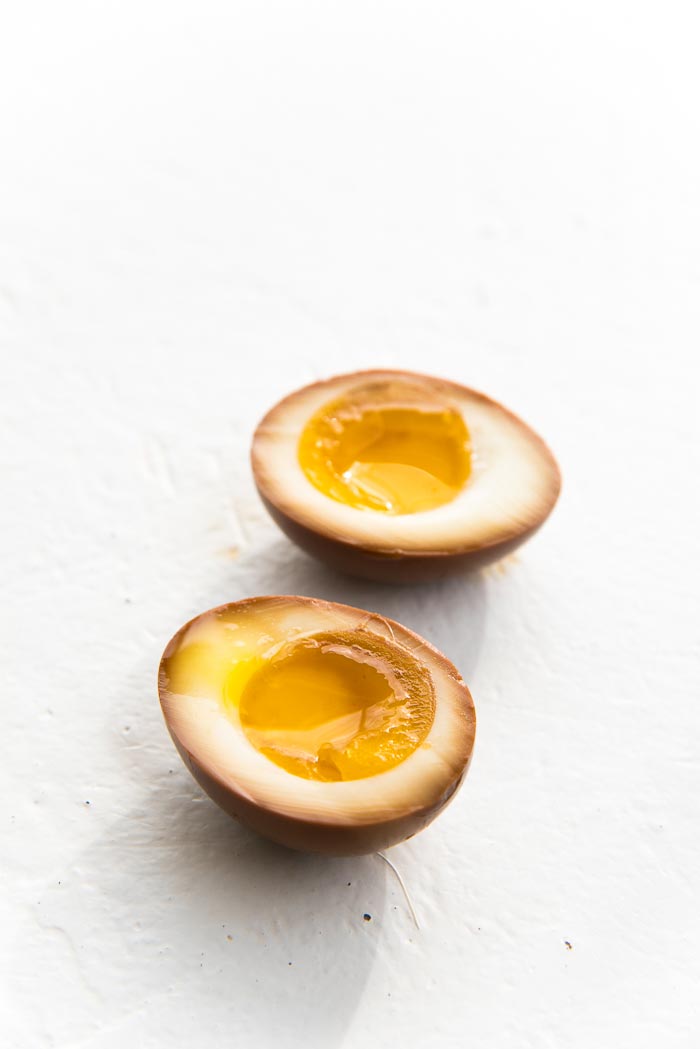
Classic ramen eggs with a jammy yolk
Recipe highlights
These spiced, soy sauce marinated eggs are filled with a creamy yolk filling made with perfectly cooked yolks, mayonnaise, and the salty umami flavor of miso.
Then they’re topped with shichimi togarashi seasoning and green onions. If you think that sounds pretty good, wait till you pop one of these bad boys in your mouth…absolutely dynamite!
These Asian deviled eggs are even better than they look! These make excellent appetizers and a perfect addition to savory breakfast recipes too.

How to boil eggs for deviled eggs
Unlike ramen eggs that have a jammy yolk, deviled eggs must have a fully cooked yolk. So, the eggs for these soy marinated ramen deviled eggs must be cooked until the yolks are just cooked through.
If the hard boiled egg yolks have a green ring, that means they have been overcooked. You’re looking for a cooked egg with a beautiful yellow yolk, and no runny spots and no green rings.


How do I cook the eggs to get perfect hard boiled eggs?
I use large eggs for this recipe. A large egg here is about 2 oz in weight.
Bring a large pot to a boil. I prefer to use a pot that can fit all the eggs in one layer at the bottom, but that’s not necessary. What’s important is for the water level to be about 1 – 2 inches above the eggs.
Add some salt to the water, cover the pot with a lid, and bring it to a boil.
When the water comes to a boil, remove it from heat temporarily to lower in the eggs. Otherwise the big bubbles may cause the eggs to move around violently and crack.
Using a slotted spoon, quickly lower the eggs into the pot. Return the pot to the heat and place the lid back on. The heat is on medium high – high, just to allow the water to come back to a boil as soon as possible (in under 1 minute).
When the water is boiling, lower the heat to a constant simmer, and start the timer for the eggs to cook. The right consistency for the egg yolks is crucial to perfect this Asian deviled egg recipe!
About 10 – 11 minutes for eggs that were at room temperature, and 12 minutes for eggs from the fridge.

How to cool down the cooked eggs quickly (with or without ice)
While the eggs are cooking, fill a large bowl with cold water and ice. Alternatively, place a bowl in the sink and fill it with cold running water.
As soon as the timer goes off, place the eggs in the bowl of water / ice to cool, and open the tap so that there is a small stream of water overflowing from the bowl. This prevents the eggs from overcooking as well.
Peeling eggs without breaking them
Once the eggs are cooled down, they can be peeled. Usually peeling jammy ramen eggs is harder, because the egg yolks are still runny and it makes the whole egg soft and easy to break.
Hard boiled eggs for deviled eggs are much easier to peel. Plus, eggs that are about a few weeks to a month old are also easier to peel, while the freshest eggs are hard to peel no matter what (as explained in my cooking and baking 101 article on the egg freshness test ).
But this is my method of peeling eggs .
- Gently crack the base of the egg shell against a flat surface.
- Then gently crack along the length of the egg.
- Then make a few more cracks across, along the width of the egg.
- Hold the egg under running water, and start peeling the egg from the base, along the length of the egg, to the top.
- Then peel off the rest of the egg shell slowly.
- Peel the egg under running water, because the water will help loosen the shell (especially when the egg is hard boiled).
- Make sure there is no membrane attached to the egg either (which will interfere with the marinating process).
Making the soy sauce marinade for the eggs
The marinade for these Asian deviled eggs is similar to the marinade for my ramen eggs. However, I make a larger amount, and also add water and sugar since there is a larger amount of eggs. They also need to marinate for longer.
Diluting the marinade will prevent the eggs from getting too salty, and the sugar balances the saltiness as well.
Another change is to infuse the soy sauce with spices. This is optional though.
What you need for the deviled ramen egg marinade
- Soy sauce.
- Dark soy sauce (optional, but adds color, and isn’t as salty as soy sauce).
- Mirin (you can also use sake, or a mix of sake and mirin instead, but mirin is easier to find for me and I always have it at home).
- Brown sugar or honey (brown sugar adds a nice molassy flavor).
- Water or ice.
- Optional spices – garlic, ginger, star anise, Chinese five spice, szechuan pepper, black pepper, cardamom, cinnamon.

The soy sauce, dark soy sauce, mirin, sugar, and spices are heated over medium high heat until it starts to boil. Let the soy sauce mix sit for at least 30 minutes to infuse with the flavors (if using), and then add the water to cool down the marinade.
The soy sauce marinade MUST be at room temperature before adding the eggs, so that it doesn’t heat or cook the eggs as they marinate.
How to make sure your hard boiled eggs marinate evenly
The common problem here is that the eggs will float to the top, which would prevent them from marinating evenly. To avoid this,
- Place a small plate / saucer over the eggs so that they stay submerged in the marinade.
- After a few hours, gently move the eggs around so that all the surfaces have a chance to marinate properly.
Otherwise, you may end up with eggs that have white spots that were not marinated properly.

Can I re-use the marinade?
ABSOLUTELY! I have mine stored in a glass jar in the fridge. Every time I make ramen eggs (with the jammy center), I just pour the marinade into a bowl with the eggs, and let them sit for at least 12 hours before eating.
After using, I put the marinade back into the jar. You can even store the marinade in the freezer if you prefer.

Preparing the marinated Asian deviled eggs
Preparing the eggs
Use a sharp, clean knife to cut the eggs in half. Make sure to cut them lengthwise and not across.
Wipe the blade clean before cutting each egg, so that you get clean cuts every time.
Carefully remove the egg yolk into a bowl. Be gentle so that you don’t break the egg whites. I find it easier to use a small spoon to gently coax out the yolks.
Place the empty egg whites on a tray or plate, and cover with a cloth napkin or plastic wrap until you’re ready to fill them.
Making the creamy miso egg yolk filling
Because of the amazing soy marinade, I keep the egg yolk filling simple.
The creamy egg yolk mixture simply involves mixing mayonnaise, white miso paste, and honey.
You can adjust the amount to your liking. I add just enough miso to season, and for that umami flavor, and mayonnaise to make the filling creamy. The flavor is balanced by adding some sweetness in the form of honey. These ingredients are whisked together until you have a creamy, delicious filling for your Asian deviled eggs.

Assembling the deviled miso ramen eggs
When the filling and the egg bases are ready, they can be filled/assembled. There are a few ways you can be creative with this step.
You can simply scoop the filling into the eggs (boring option), but piping in the filling definitely makes the eggs more appealing.
I like to add a generous sprinkling of shichimi togarashi to the egg yolk filling. To keep the egg yolk filling bright yellow, I prefer to sprinkle the spice mix onto the egg white base first. Then I pipe the filling, and sprinkle more spices on top, along with freshly chopped spring onions (or chives).
Alternatively, I also like to add just a little of the marinade into the egg base first. Then pipe the filling on top, and top it all off with the spice mix and spring onions. This way, the bottom of the egg yolk filling absorbs the marinade.

Serving suggestions (toppings)
As mentioned, I like the simple addition of togarashi and spring onions on my soy marinated Asian deviled eggs.
But there are plenty of other options as well.
- Chives
- Parsley
- Cilantro
- Sesame seeds
- Furikake seasoning
- Nori
- Salmon roe (Ikura)
- Paprika

Why I love this recipe
I’ll give you one reason that makes this recipe absolutely worth your while. The marinade .
I make these miso deviled eggs often and LOVE eating it with plain rice, a little chili oil, and a generous amount of the marinade over the rice. That’s how good this is. They even go well with breakfast fried rice .
I love how these Asian ramen deviled eggs have that outer ring of marinade that makes them both flavorful AND beautiful.
The flavors are perfectly balanced with creaminess, a touch of sweetness, and the umami flavor. They are impressive as party starter recipes , and they are also one of our favorite small Thanksgiving dinner recipes too.

Recipe
Asian Deviled Eggs (Miso Ramen Deviled Eggs)
Ingredients
- 12 large eggs preferably at room temperature ( 2 oz / 57 g each)
- Salt to salt the water
Marinade (make the marinade first to let the flavors infuse, and give it enough time to cool down)
- 1 cup soy sauce
- ½ cup dark soy sauce or ketjap manis
- ½ cup brown sugar 100 g
- 1 cup mirin
- 1 ½ cups water cold water
- 2 star anise
- 5 cardamom pods optional
- 3 tbsp whole black pepper optional
- 4 garlic cloves optional
- 1 inch ginger sliced, optional
- ½ tsp Chinese five spice optional
Miso egg yolks filling
- 3 - 4 tbsp white miso
- ¼ - ⅓ cup good quality mayonnaise
- ½ tbsp honey
- ½ tsp white pepper optional you can use black pepper as well
To garnish (use 1 - 2 of these options)
- Shichimi togarashi
- Finely chopped green onions
- Furikake
- Ikura salmon roe
- Sesame seeds
Instructions
Making the hard boiled eggs
- Generously fill a large pot (large enough to fit the eggs at the bottom in one layer) with water and salt. The water level should be about one inch above the eggs. The salted water will prevent the egg whites from leaking out too much if the eggs crack. Salt
- Cover the pot and bring the water to a boil.
- When the water is boiling, remove it from the heat temporarily, and then quickly (but carefully) lower the eggs into the water. 12 large eggs
- Immediately return the pot to the heat, and cover with a lid. Let it come to a boil on high heat (it should take no longer than 1 minute to come to a boil, preferably within 30 seconds).
- When the water comes to a boil, lower the heat to a simmer, and immediately start the timer for 11 minutes.
- In the meantime, get a large bowl ready with cold water and ice (or very cold water from the tap).
- As soon as your timer goes off (i.e. 11 minutes), quickly transfer the eggs into the bowl with water and ice. Alternatively, place the eggs in cold water, but make sure there is a constant flow of water going in and out of the bowl, from the tap. This will help to cool down the eggs faster.
- Allow the eggs to cool down completely.
- Peel the eggs under running tap water (see notes in the post on how I peel these eggs). Take care not to crack or break the eggs.
- Place the eggs in a bowl until you’re ready to use them.
Marinade (make the marinade first to give it time to cool down)
- Place the soy sauce, dark soy sauce, sugar, and mirin in a pot. Add the spices that you’re going to use as well. 1 cup soy sauce, ½ cup dark soy sauce, ½ cup brown sugar, 1 cup mirin, 2 star anise, 5 cardamom pods, 3 tbsp whole black pepper, 4 garlic cloves, 1 inch ginger, ½ tsp Chinese five spice
- Heat the mix over medium heat and bring it to a simmer. Let the mixture simmer for about 5 minutes, with the lid on.
- Remove from the heat, and allow the spices to infuse the soy sauce for at least 20 minutes.
- Stir in the cold water, and allow the marinade to come to room temperature, or chill it in the fridge to cool it down faster. You don’t have to remove the spices from the marinade. 1 ½ cups water
- Once the marinade is at room temperature or chilled, it’s ready to be used.
Soy sauce marinated eggs
- Place the marinade in a large bowl or container. Place the eggs in the marinade, and make sure the eggs are fully submerged in the marinade. Use a small plate or saucer to help keep the eggs submerged.
- The eggs should be in the marinade for at least 8 hours, or up to 24 hours. Move the eggs around in the marinade once or twice to ensure even marinating.
- Remove the ramen eggs from the marinade and place them on a plate or bowl.
- Cut them in half (lengthwise), with a sharp clean knife. Make sure to clean the blade before each cut, so that you get clean cuts.
- Carefully scoop out and transfer the yolks into a bowl, and place the egg white halves on a tray.
- Next, make the egg yolk filling once you have scooped out all the yolks into a bowl.
Miso egg yolk filling
- Add about ¼ cup of mayonnaise and 1 tbsp of miso, pepper, and honey with the egg yolks and mix until creamy. Add the rest of the mayonnaise and miso to make the filling creamy enough to your liking or to add flavor ( only if needed ). Please note to adjust the amount of miso to your liking, or it can be too salty. 3 - 4 tbsp white miso, ¼ - ⅓ cup good quality mayonnaise, ½ tbsp honey, ½ tsp white pepper
- Place the filling in a pastry bag with a star tip (or any pastry tip) attached.
Asian deviled eggs - assembly
- Sprinkle a generous amount of togarashi in each of the egg white halves. Shichimi togarashi
- Optional - add just a few drops (less than ¼ tsp) of the soy sauce marinade into each of the egg white halves.
- Carefully pipe the egg yolk filling into the egg whites, over the togarashi (and marinade liquid, if using).
- Sprinkle your choice of toppings on top. Here I used togarashi and spring onions. This can be done just before serving. Finely chopped green onions, Furikake, Ikura, Sesame seeds
- Loosely cover the deviled eggs with plastic wrap or keep them in an air-tight container and refrigerated until you’re ready to serve.
Notes
Nutrition
Recipe from The Flavor Bender by Dini Kodippili
Asian Deviled Eggs (Miso Ramen Deviled Eggs) https://www.theflavorbender.com/miso-ramen-asian-deviled-eggs/
