
Light as air, crisp, perfectly sweet, bite-sized meringue cookies (meringue kisses) are such a nostalgic treat for me! You only need a handful of ingredients, and they are super duper easy to make.
You can easily add color, texture, and flavor to these versatile cookies, and they are great for gift-giving during the holidays too.

- Why this recipe works
- What are meringue cookies?
- Ingredients you’ll need
- How to make meringue cookies
- Recipe variations
- My best recipe tips
- Frequently asked questions
I have so many fond memories of eating these crisp, melt-in-your-mouth meringue cookies as a kid.
Only we called these meringue kisses, but they were so fun, because they weren’t like regular cookies, and they were plenty sweet for us kids. Plus, we re-purposed any leftover kisses to make eton mess!
These are a little too sweet for my grown up self now though, ha!, but you can’t deny the nostalgic magic these cookies possess, especially during the holidays!
They are honestly perfect as Christmas cookies , and great for gift-giving too.
Why this recipe works

- Perfect, kid-friendly, light and airy, bite-sized sweet treats , especially for the holidays. Great for gift-giving .
- Super easy, and you only need a few ingredients to make these.
- I share my meringue hacks to help you get perfect results every time!
- These are a great way to use up leftover egg whites .
- Very versatile recipe , so easy to add flavor, texture, and fun colors. And you can make them extra special by decorating them in fun ways too.
- Naturally gluten free .
What are meringue cookies?
Meringue cookies are whipped egg whites that you pipe and bake at a low temperature until they dry out and become crisp and light!
They are super simple to make, have an incredibly light, crisp, melt-in-your-mouth texture and sweet flavor.
Meringue is the foam that’s formed by whipping egg whites. However, this foam is not stable and will collapse over time and not form crispy meringues. We add sugar to make the cookies sweet, but also to provide stability to the foam.
Three ways to make meringue
There are 3 ways to make meringue , but only 2 of these are best for making meringue cookies.
- French meringue – Adding sugar slowly to the fresh egg whites while whisking, and then whisking until it forms stiff peaks (that’s the method I use here).
- Swiss meringue – Heating the sugar and egg whites over a bain marie (double boiler) to reach a certain temperature, and then whisking this (off heat) until it forms stiff peaks.
- Italian meringue – Making a sugar syrup at firm ball stage, and adding this to the egg whites while whisking. Then whisking to stiff peaks.
While Italian meringue is the most stable meringue, it isn’t suitable for meringue cookies. Because it contains more moisture than the other two methods. So, if the cookies don’t dry out properly, they will be chewy and sticky instead of crisp.
I use the simplest method, French meringue to make these meringue cookies (kisses).

Difference between meringue and pavlova
As a Kiwi, this is a question that’s near and dear to me. And I also find it INCREDIBLY frustrating to see a lot of people make meringues and then call them pavlova.
A pavlova is made WITH a meringue, just like meringue cookies or other baked meringues.
However, a meringue will ALWAYS have a dry, crisp interior. They are baked until the meringue completely dries out to form a crisp exterior AND crisp interior.
A pavlova on the other hand has a SOFT, MARSHMALLOW interior. While the outside is a crisp exterior. That soft and marshmallowy interior is non-negotiable for a pavlova, and what makes it that fantastic dessert that it is.
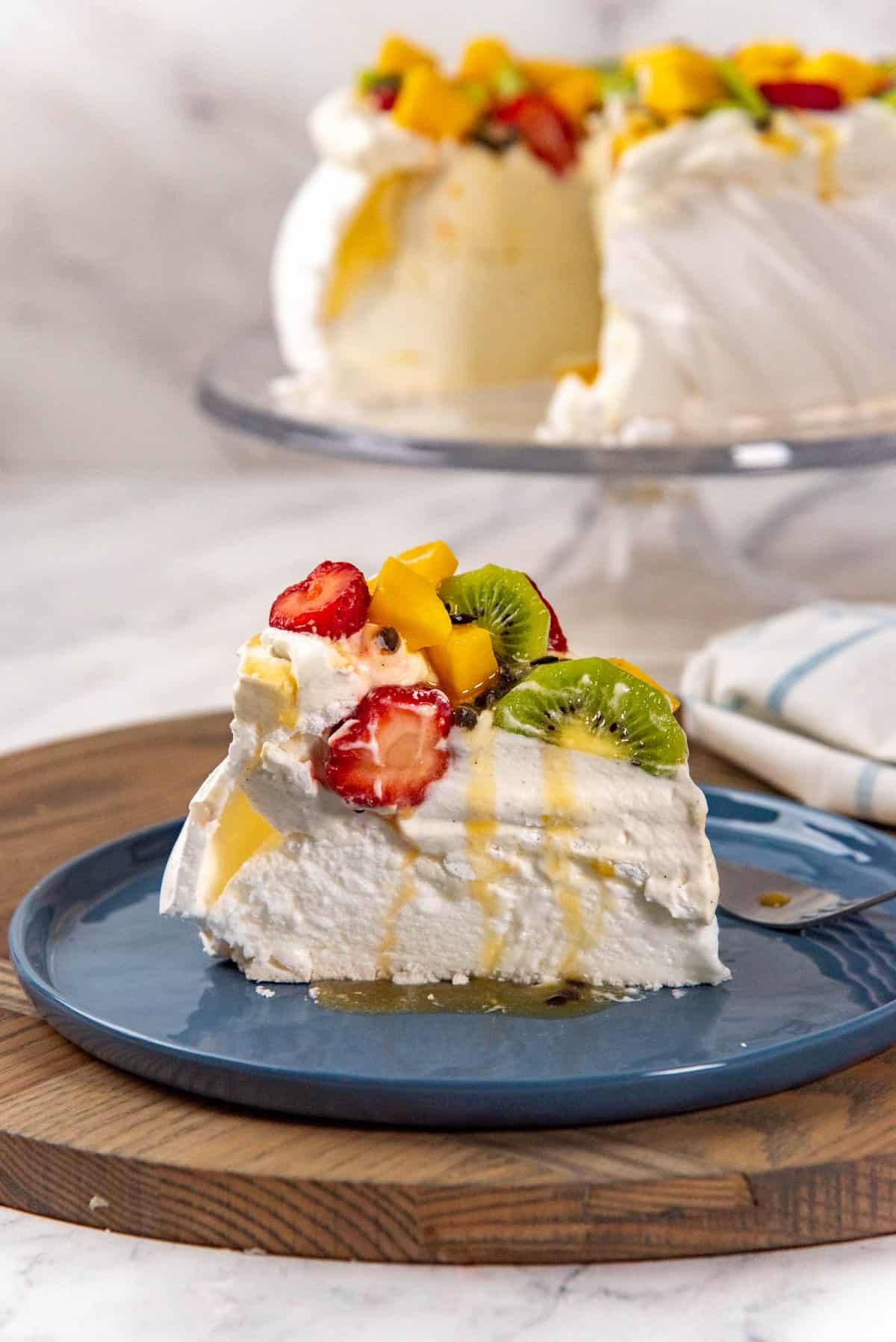
Theperfect pavlovawith a marshmallow-like soft interior

Meringue vs Pavlova
Both are made with egg whites and sugar, and baked in an oven. However,
- If the inside is crisp and dry = it’s a meringue
- If the inside is soft and marshmallow-like = it’s a pavlova
Ingredients you’ll need

- Fresh egg whites
- Caster sugar (extra fine sugar)
- Cream of tartar
- Vanilla extract
- White vinegar (to wipe and clean all bowls, utensils etc.)
Ingredient notes
- Egg whites should be fresh. Pasteurized egg whites from a carton do not whisk to stiff peaks like fresh egg whites.
- Caster sugar will dissolve more readily because it’s finer than granulated sugar. You could use confectioner’s sugar, but confectioner’s sugar can contain cornstarch that might change the texture of the baked meringue. See my complete guide to types of sugar for reference.
- If you do not have caster sugar , you can process granulated sugar in a food processor so that it has a finer ground. However, make sure the processor does not have any fat residue in the bowl or blades.
- Cream of tartar is used to add acidity to the egg whites. Acid helps to break the egg white proteins, so that we can whip the egg whites more easily, and they can hold air with more stability.
- Substitute for cream of tartar – While you could potentially leave out cream of tartar, adding it helps with the stability of the egg whites. Instead of cream of tartar, you can use twice the amount of white vinegar instead.
- Vanilla extract adds flavor. You can add salt too, but meringue cookies are one of those sweet desserts that doesn’t really need salt.
- White vinegar – I use white vinegar in this recipe as a precaution to guarantee success. When working with egg whites, I’m extra careful with contamination. Wiping everything down with vinegar removes any trace amounts of fat. If anything contains fat, or gets broken egg yolk on it, I either replace it or IMMEDIATELY wash and wipe it down with white vinegar.
How to make meringue cookies
Step 1 – Clean all equipment

Make sure all the equipment, bowls, and utensils are squeaky clean. Washed with soap and no greasy residue.
Then wipe them all down with white vinegar by soaking a paper towel and squeezing out excess, and using as many paper towels to ensure there’s no contamination (image 1) . This includes,
- Mixing bowl
- Whisk attachment
- Spatulas
- Bowl that individual eggs will be cracked over
- Egg separator
- Bowl that will store the egg whites
- Bowls to measure sugar and other ingredients
- Spoons that will be used in the recipe
Step 2 – Separate the egg whites

Cold, fresh eggs are the easiest to separate, as the yolk will have a thicker and firmer membrane . Older eggs or room temperature eggs will have a thinner yolk membrane that will easily break. (See my guide on how to tell if eggs are fresh for more information.)
So, use fairly fresh eggs, straight from the fridge to make the separating process easier.
Use an egg separator, or your fingers to separate the egg yolk from the white. But make sure your fingers are clean with no oil or fat to contaminate the egg white.
Separate one egg by cracking it over the egg separator placed over a bowl (image 2) . Once the egg white goes through to the bowl without breaking the yolk, transfer the egg yolk into a container with cold water (to store for later) (image 3) . Then transfer the separated egg white into another bowl (image 4) .
Repeat until you have the right amount of egg whites (image 5) . Keep the egg whites aside to let them come to room temperature (while you get things ready).

Why break eggs over a separate bowl?
In case a yolk accidentally breaks during the separating process. If that happens, we can’t use that egg white, and the whole egg would need to be put aside. Plus, we’ll have to wash and clean the egg separator and the bowl before using again.
However, since we were separating only one egg at a time, the yolk didn’t contaminate all the other separated egg whites in the other bowl! This is why we separate eggs over one bowl, and then transfer the separated egg whites into a different bowl.
Even trace amounts of egg yolks will prevent the egg white from forming a meringue.
Step 3 – Measure other ingredients and prep baking pans
To get stable meringue, it’s important to get the egg white to sugar ratio correct.
To make sure the meringue doesn’t collapse, there should be a minimum of 1.7 – 2 parts sugar for 1 part egg white .
So for this recipe, 100 g of egg whites will need a minimum of 170 g sugar to create a stable meringue that you can pipe properly.
Preheat your oven to 200 F / 93 C (convection oven).
Line a half sheet pan with parchment paper or silpat.
Prepare a large piping bag with a piping tip of your choice. You can also pipe these without a piping tip for smooth meringue cookies. If you don’t have a piping bag, you can use a Ziploc bag, or just use spoons to spoon dollops of meringue instead.
Step 4 – Adding the sugar to make meringue
Once the egg whites are separated and weighed, and the sugar is weighed out, you’re ready to make the meringue.

Place the egg whites in the mixing bowl, along with the cream of tartar (image 6) . Whisk on medium speed to whisk the egg whites until they become frothy with small bubbles (not large bubbles) (image 7) .
Start adding the sugar, streaming in one spoonful at a time (image 8) , with a few seconds between each spoonful. Adding too much at once can cause the meringue structure to break down too early and too quickly.
After you add all the sugar, stop whisking, and use a clean metal spoon to scrape down the sides of the bowl to mix in any sugar that might be stuck to the sides (images 9 – 10) .
Step 5 – Whisking to stiff peaks

After scraping down the sides of the bowl, start whisking the egg white mixture again on medium high speed (image 11) .
When the meringue starts to look glossy and white, you can increase the speed further and whisk until you have stiff peaks (image 12) .
The time will vary, but make sure the sugar is completely dissolved as well.
Once the meringue has reached stiff peaks, add in the vanilla and whisk it in for about 1 – 2 minutes.
Stop whisking, remove the bowl from the stand mixer, and fold the mixture to ensure the vanilla is mixed in.
Step 6 – Piping meringues

Scrape the mixture into the piping bag (image 13) and twist the end to close. Use some of the remaining meringue to stick the parchment paper to the baking tray. This will prevent the parchment paper from moving when you pipe meringue on top.
Hold the piping tip perpendicular to the prepped baking tray. While the tip is above the tray (and not touching), squeeze out the meringue to create a dollop, and pull the tip slightly upwards as you stop squeezing the meringue (image 14) .
This creates a tip on the meringue cookies (as you can see in the pictures) which will resemble the shape of Hershey’s kisses (image 15) .
Repeat piping meringue cookies with about 1 inch of space between the cookies, until the whole tray is filled.
Step 7 – Baking the meringues
Place the baking tray in the preheated oven. Bake for 1 hour 30 minutes for small bite-sized meringue cookies, and 2 hours for larger meringue cookies.
You will know that the meringue cookies are baked when a meringue cookie will lift off the parchment paper cleanly and easily (image 16) .
After baking, turn off the oven and let the cookies cool INSIDE the oven for about 2 hours. This is so that the meringue cookies will dry out further as they cool down gradually in the warm oven.
Step 8 – Storage
Once completely cooled down, you can serve the meringue cookies! You can also dip them in chocolate and let them set (images 17 – 18) , or go a step further and dip the chocolate in chopped nuts before it sets too.

Once the meringues have cooled down, and after the chocolate sets, the meringue cookies can be stored in an airtight container for about 2 weeks at room temperature .
I do not recommend refrigerating meringue cookies. However, you can store them in the freezer!
Frozen meringue can be left out to thaw to room temperature, but eat them immediately after thawing them out to prevent them from getting soggy.
Frozen and thawed meringue cookies will get sticky and chewy faster.
Recipe variations
How to make colored meringue cookies
You can add gel food coloring along with the vanilla extract to create colored meringue cookies.
How do I add colored swirls?
You can add a few drops of gel food coloring to the meringue after mixing in the flavor extract. Then use a spatula to partially mix in the food coloring to create swirls.
Alternatively, take about 1 cup of meringue into a separate bowl and fold in gel food coloring. Then add this back to the rest of the meringue and partially fold it in.

Can I make flavored meringue cookies?
You can absolutely add flavor extracts (alcohol or water based, and not flavoring oils) such as almond extract, peppermint extract, lemon, or other fruit extracts to create flavored meringues. Add the extract along with, or instead of, the vanilla extract.
You can add freeze dried fruit powder, but I find that it can make the meringue more chewy because the fruit powder draws too much moisture. Resulting in the meringue deflating while it bakes, or not fully drying out.
Cocoa powder can be sifted over the meringue mixture and folded in to create swirled chocolate meringue as well.


My best recipe tips
- Any grease or fat is the enemy of meringue. Even having a microscopic amount of yolk in the egg white will prevent the egg white from whisking into a meringue. This is why you must take extra precaution to make sure there is no fat or egg yolk in the egg whites, sugar, and all the equipment as well.
- Plastic bowls can contain hidden grease in porous surfaces. That’s why metal or glass bowls are recommended for whisking egg whites .
- Fresh eggs are easier to separate than older eggs. Cold eggs are also easier to separate than warm or room temperature eggs. This is because they have thicker, more sturdy egg yolk membranes that do not break easily. Aging causes the membranes to become thinner and weaker in eggs.
- For best results, ALWAYS separate one egg at a time into a separate bowl , before transferring the egg white into a larger bowl / mixing bowl. This way, if a yolk does break, then you don’t have to throw out everything, and only need to replace the one egg (with the broken yolk).
- Store egg yolks in a container with cold water, making sure they are completely submerged and unbroken. These yolks should be used within 4 days.
- Use the recommended minimum amount of sugar to make meringue cookies. If you reduce the sugar, the meringue can also collapse easily as you pipe and bake them.
- Make sure you add sugar in a gradual stream , rather than dumping in the sugar too quickly. This will keep the meringue light, and allow it to develop a stable foam gradually.
- Be patient and whisk the meringue till it reaches stiff peaks . Meringue with a stiff peak will pipe better and hold its shape, and retain the shape as it bakes.
- Make sure the sugar dissolves in the meringue. If there is a lot of undissolved sugar in the meringue, it can cause the meringue to weep or crack as it bakes.
- Allow the meringue cookies to cool down in the oven , so that they gradually cool down while drying out.

Why are my meringue cookies chewy?
Meringue cookies get chewy when they are exposed to high humidity. If the meringue is chewy right after baking and cooling, then these cookies needed more time to bake and dry out. If they become chewy after storing them, it’s just because they are absorbing humidity in the environment. You can store them with a desiccant to prolong their crispness.
My meringue cookies are weeping
Weeping is where the meringue has pools of liquid settle under it as it bakes. I have pictures of this in my pavlova recipe post. The liquid does harden after baking as the meringue dries. This happens because there’s too much undissolved sugar in the meringue that melts away and pools on the baking tray.
My meringue cookies are flattening in the oven?
Meringue cookies flatten in the oven because they are losing their stability. This happens if the cookies were never whipped to stiff peaks properly, or were contaminated with fat through the piping bag or piping tip. Using less sugar in the recipe can also cause the meringue to flatten as it bakes. Adding too much moisture with additions to the meringue mixture can also cause them to flatten in the oven.
Why is my meringue not reaching stiff peaks?
While patience is required to get the egg whites to stiff peaks, if they are not reaching stiff peaks at all, it’s usually because there was some contamination during the whisking process.
What can I do with leftover egg yolks?
So many options to use egg yolks! You can make pastry cream , lemon curd , vanilla ice cream for sweet options. Egg yolks can also be used to make mayonnaise or egg yolk pasta as well.

Recipe
Meringue Cookies (Meringue Kisses)
Ingredients
- 100 g fresh egg whites from about 3 large eggs (please see recipe notes)
- 170 g caster sugar generous ¾ cup
- ¼ tsp cream of tartar
- 2 tsp vanilla
- 1 Pinch salt optional
- White vinegar
Instructions
Tips to prepare for egg whites
- Separate the egg whites from the eggs. It’s crucial to use fresh egg whites that have not been contaminated with any fat residue. Even a little bit of fat or egg yolk will prevent the egg whites from forming into a meringue. See recipe notes for tips on how to separate egg whites with minimum grease contamination. White vinegar
- Measure the ingredients and place them in separate clean bowls.
- Preheat the oven to 200°F / 93°C (convection oven).
- Line a half sheet pan with parchment paper or silpat. Set aside until needed.
Making the meringue base
- Place the separated egg whites (make sure that NO yolks were broken), in the clean mixer bowl. 100 g fresh egg whites
- Add the cream of tartar and a pinch of salt (if using). ¼ tsp cream of tartar, 1 Pinch salt
- Place the bowl in the stand mixer with the clean whisk attachment attached.
- Start whisking at medium speed until the egg whites become foamy.
- Start adding the caster sugar one spoonful at a time (stream in the sugar from the spoon), with about 5 - 10 seconds between each spoonful. Adding too much sugar at once can cause the egg whites to lose structure and not be able to create a stable foam. 170 g caster sugar
- Once all the sugar is added, stop whisking, and use a clean metal spoon to scrape down sugar that might be stuck to the sides of the bowl.
- Resume whisking the meringue mixture on medium - high / high speed, until the egg whites are glossy, thick, and reach stiff peaks. Make sure the mixture has no undissolved sugar.
- Add the vanilla and mix it in on low / medium speed. 2 tsp vanilla
- OPTIONAL - if you want to add color, you can add it along with the vanilla. If you want to make a color swirled meringue, place about 1 cup of meringue mixture in a separate (clean) bowl and add gel food coloring and fold it in. Then add the colored portion back into the rest of the meringue and partially fold it in to create swirls.
Piping meringue mixture
- Place a piping tip in a large piping bag. Cut the end of the piping bag so that the piping tip can fit comfortably. I use a French star tip with a ¾ - 1 inch opening. You can also use an open star tip or round tip.
- Stuff a little bit of the piping bag into the piping tip to create a seal at the end with the piping tip.
- Fill the bag with the meringue mixture, making sure there is enough room to twist and seal the meringue bag to make it easier to hold and pipe.
- Un-block the piping tip and push down the meringue mixture with minimal air pockets. Twist the open end to close.
- Pipe meringue mounds on the prepared half sheet pan. To make the shapes in the post, hold the piping bag perpendicular to the baking pan, and squeeze the meringue out just above the sheet pan to create a thick base, and then slowly lift the piping bag as you stop squeezing out the meringue. Remove the tip and piping bag straight up after you’re done to create that pointed end.
- Repeat to fill the baking pan. Leave about 1 inch of space between the meringues. They shouldn’t expand too much.
Baking meringue cookies
- Place the meringue cookies in the middle rack in your preheated oven. Usually you will only be able to bake one sheet at a time to ensure even baking. If you do have a multi rack oven, follow your oven manual to know where to place the baking racks.
- Bake the meringue cookies for about 1 ½ hours for smaller cookies, and 2 hours for larger cookies. Meringue cookies that are done baking will easily pull off the parchment paper.
- Once baked, switch off the oven and let the meringue cookies cool for a minimum of 2 hours in the oven . This gradual cooling down is essential for properly drying out the cookies for a crisp texture.
- After the meringue cookies have cooled down in the oven, remove them from the oven and let them cool down completely at room temperature. Then place them in an airtight container.
Chocolate dipped meringue cookies
- If you’d like to dip the meringue kisses in chocolate, melt chocolate over a double boiler or in the microwave.
- Temper the chocolate for best results. I use the seeding method by adding about 10% more chopped chocolate into the melted chocolate and mix it until the chocolate melts. The temperature should be about 90°F for tempered dark chocolate.
- Then carefully dip the meringue base in the melted chocolate, and place them on a parchment paper.
- Once the chocolate is set, you can store them in an airtight container.
Notes
Tips to ensure clean egg whites
- Make sure the mixer bowl, whisk, all the bowls, utensils, and spatulas are completely clean, with no greasy residue on them. I prefer to use a glass or metal bowl to whisk egg whites, because plastic bowls can have hidden greasy residue.
- To ensure perfect results, wipe down all the bowls, utensils etc. with a clean paper towel that has white vinegar. The acidity will help remove trace amounts of grease that may be present.
- Fresh eggs are easier to separate than older eggs.
- Cold eggs are also easier to separate than warm or room temperature eggs.
- I like to crack open an egg into an egg separator that’s placed over a clean bowl to separate the egg white from the yolk. If separated successfully, transfer the egg white into a different clean bowl, and the egg yolk into a container with cold water.
- For best results, ALWAYS separate one egg at a time into a separate bowl, before transferring the egg white into a larger bowl / mixing bowl with the other egg whites. This way, if a yolk does break, then you don’t have to throw out everything, and only need to replace the one egg (with the broken yolk).
- Place the egg yolks in a container with cold water, making sure the yolks are submerged in the water. Use these yolks within 4 days.
Storage tips
Nutrition
Recipe from The Flavor Bender by Dini Kodippili
Meringue Cookies (Meringue Kisses) https://www.theflavorbender.com/easy-meringue-cookies-kisses/
