
The most comprehensive, reliable, failproof recipe to make perfect Swiss meringue! This Swiss meringue is heated to over 170°F, making it more stable and perfectly safe to eat, with beautiful, glossy stiff peaks!
Use it to make classic lemon meringue pie , lemon meringue cocktail , passion fruit pie or any other application and learn to make different variations too with this foolproof recipe.
- Why this recipe works
- What is swiss meringue?
- Recipe ingredients
- Crucial tips to follow to make successful meringue
- How to make swiss meringue
- Ways to use swiss meringue
- Variations
- What do to with leftover egg yolks?
- Troubleshooting and frequently asked questions
Why this recipe works

- There are many recipes for swiss meringue out there. But in this recipe, I dissect each step, so you can understand what happens at each stage in a Swiss meringue and why it’s important.
- With that information and all the tips I share, I help you troubleshoot any issues you may encounter, so that you can always make perfect, failproof Swiss meringue .
- These tips also ensure beautiful, glossy stiff peaks in your meringue.
- This swiss meringue recipe is heated to 170°F. This makes the meringue more stable AND safe to eat .
What is swiss meringue?
Meringue is the foam that you create by whipping egg whites with sugar . There are different ways to make meringue. Swiss meringue is one of the methods to make egg white meringue.
Swiss meringue vs Italian meringue vs French meringue
Three different methods of making meringue.
- French meringue – Adding fine white sugar to egg whites, while whisking the egg whites. This is the most common way of making meringue.
- Italian meringue – A hot sugar syrup with a high sugar concentration is added to the egg whites while whisking the egg whites.
- Swiss meringue – The egg whites and sugar are heated together to dissolve the sugar. Then the egg white and sugar mixture is whisked.
French meringue , while common, is not stable. This method is used for meringue bases that will be cooked or baked. For example, pavlova , meringue cookies , macarons, and floating islands are all made with french meringue.
Italian meringue is the most stable of all meringues. It’s great to be used to top dessert pie recipes (and other sweets) because it does not break down and weep easily. It’s not great for baking, as the additional water content makes it harder for it to dry out. But it makes great buttercream.
Swiss meringue is more stable than French meringue, but not as stable as Italian meringue. But, it’s also commonly used to top lemon meringue pie and passion fruit pie , and used in other applications as well! Just like Italian meringue, swiss meringue is also great for making buttercream.

Usually swiss meringue is only heated until the sugar dissolves, which isn’t safe to eat raw, unless you use pasteurized eggs. Italian meringue is said to be safe to eat raw because the hot syrup “cooks” the egg white – but it’s hard to know for sure if the sugar syrup uniformly heats the egg whites to 170°F+ to pasteurize the egg whites.
French meringue is not heated at all, and must be baked before consuming.

What’s different about this Swiss meringue recipe
With my swiss meringue recipe, the egg white and sugar mixture is heated to 170°F+, making it safe to eat!
Many recipes for swiss meringue call for the egg white mixture to be heated only until the sugar dissolves. The temperature of the egg whites for the sugar to dissolve will be around 100 – 140°F.
But, I prefer to heat the mixture till it’s 170°F +, so that the sugar is dissolved, the meringue is pasteurized, and the meringue is slightly more stable than if it was only heated to 140°F.
Recipe ingredients
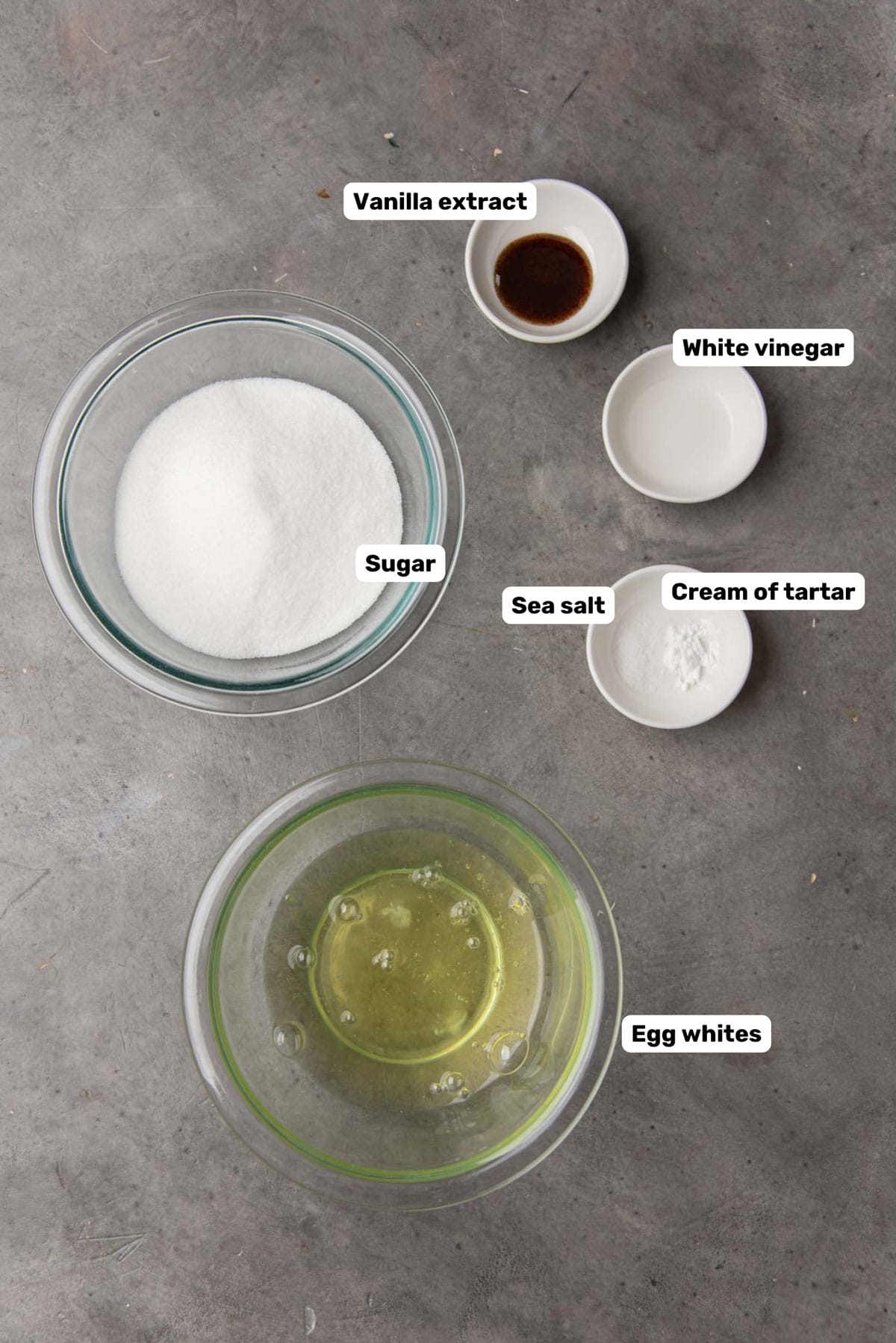
- Fresh egg whites
- White granulated sugar
- Cream of tartar
- White vinegar
- Salt
Optional
- Vanilla bean
- Lemon extract
Ingredient notes
- The egg whites need to be ABSOLUTELY free of any kind of fat . This includes egg yolk or any residual fat that might be on any surface that the egg white comes into contact with.
- Fresher eggs are easier to separate, and also create a more stable meringue. So, it’ll be easier to work with fresh eggs . I often use the egg float test (egg freshness test) to determine the suitability of my eggs to make meringue with.
- Sugar is an important ingredient in meringue. The ratio of sugar to egg whites is crucial for stability. For the highest stability, add twice as much sugar as egg whites (by weight) . But there is some wriggle room here.
1 egg white = about 30 g.
For every 1 egg white (30 g), use between 45 – 60 g of sugar for making most meringues.
For this swiss meringue recipe, I use 50 g per 1 egg white . But, if I were making pavlova , I would use 60 g to give it more stability.
Crucial tips to follow to make successful meringue
I’ve come across many people trying to make meringue, but get frustrated by not getting the lofty, stiff, glossy meringue they are looking for, even after spending so long whisking the egg whites.
Did you follow the recipe as best as you could, but just ended up with liquid egg whites that will not stiffen? Then these tips are for YOU!
While I have shared a few tips here, I also include pro tips for each recipe step in the highlighted sections in the “How to make Swiss meringue” section below.
- Use fresh eggs over old eggs. Fresh eggs have a thicker egg white which can create a stable meringue. Older eggs have a thinner egg white which will hold more air (more volume), but the foam is less stable.
How to tell if eggs are fresh?
Fresh eggs have a smaller air pocket within the shell. Therefore it sinks and lays flat on the bottom.
As the egg loses its freshness, more CO2 / air enters the egg through the shell. This causes the air bubble to get bigger and makes the egg more buoyant.
If the egg is still good to eat, but not as fresh (1 – 2 weeks), the egg will sink, but one end of the egg will point up, staying vertical without laying flat on its side.
However, if the egg is not fresh at all, or has gone bad, then the egg will float because the air pocket has become large.
Check out my detailed egg float test article where I describe how to tell if eggs are fresh and what applications to use different eggs for.

You can use the egg shell, your fingers, or even an egg separator to separate the egg yolk from the white. But, for beginners, I recommend using a metal egg separator. If using the shell, be careful not to pierce the egg yolk with the shell edge. And if you use your hand / fingers, please make sure your hands are completely clean and dry (our hands can have lots of fatty residue on them!).
When heating the egg whites and sugar, make sure the water is simmering in the double boiler. Whisk the mixture very frequently to prevent the egg whites from cooking and curdling.
Use a thermometer to check the temperature of the egg white mix, but clean the tip of the candy thermometer as well to make sure there is no oil or fat on the thermometer probe.
Whisk the meringue mixture on high speed until you just pass the soft peak stage. After that, whisk the meringue on medium high until you reach stiff peaks. This way it’s easier to monitor the meringue and prevent it from over-whisking.
If you’re adding vanilla, add it during the last 2 – 3 minutes of whisking. If the extracts contain any fat, this will destabilize the meringue, so be careful!

How to make swiss meringue
Step 1 – Prepare all the bowls and utensils
Clean and dry your mixing bowl, whisk, and all other utensils that will come into contact with the egg whites and sugar. I like to clean them with hot water and soap to ensure there is no trace of fat (image 1) .
Clean metal or glass bowls work the best! Plastic, wood, silicone utensils usually can have fat residue, which will interfere with the process of making meringue. The egg whites may still whisk, but never reach stiff peaks. Metal and glass are easier to clean, and there is less chance of any fat contamination.
Take extra care by wiping the bowls, whisk attachment, and utensils with white vinegar. The acidity of vinegar helps to keep the bowls clean and remove any oil residue. Additionally, acidity doesn’t interfere (and can help) with making meringue. Just make sure it’s white vinegar and not a flavored vinegar.
Step 2 – Separate the egg whites from the yolks
Carefully separate the egg whites in the egg. You can use the shell to do this, or your hands. But make sure your hands are very clean.
Alternatively, you can use an egg separator for convenience. Be very careful not to break the egg yolk, because even a trace of egg yolk in the egg white will prevent the egg whites from forming a meringue.
It’s easier to separate the egg whites from the yolk if the eggs are fresh. Cold eggs are also easier to separate.
Separate each egg white into a smaller bowl before transferring each into the big bowl. That way, if you accidentally break the yolk in 1 egg, the rest of of the egg whites will not be contaminated!
All the egg whites can be placed in the mixing bowl (image 2) . Each egg white should be around 30 g.

Step 3 – Add other ingredients
Add the sugar and cream of tartar to the egg whites and whisk gently to break up the egg whites and mix a little with the sugar (image 3) .
If you don’t have cream of tartar, you can also use white vinegar or citric acid! The acid will help denature the egg white proteins that will help keep the meringue more stable.
Sugar will help increase the viscosity of the egg white that will also keep the meringue foam stable. For every egg white, add about 50 g of sugar.
Step 4 – Heat the egg white mixture over a double boiler
Heat about 2 inches of water in a pot and bring it to a simmer (image 4) . Place the mixing bowl (with the egg whites and sugar) over the simmering water and continuously whisk to heat the the egg white mixture evenly and slowly (image 5) .
The mixture will be heated to between 170 – 175 F. I use a digital thermometer to check the temperature. The egg whites will go from an off white frothy consistency to a bright white, thick mixture that resembles royal icing (images 6 – 7) .
The purpose of heating the egg whites is to dissolve the sugar and pasteurize the egg whites. But another result of heating the egg whites is the denaturation of the egg proteins AND increasing the viscosity of the egg whites, which also help to create more stable foam.

Step 5 – Whisk the heated egg whites
When the egg white and sugar mixture has reached 170 – 175 F, it’s ready to be whisked!
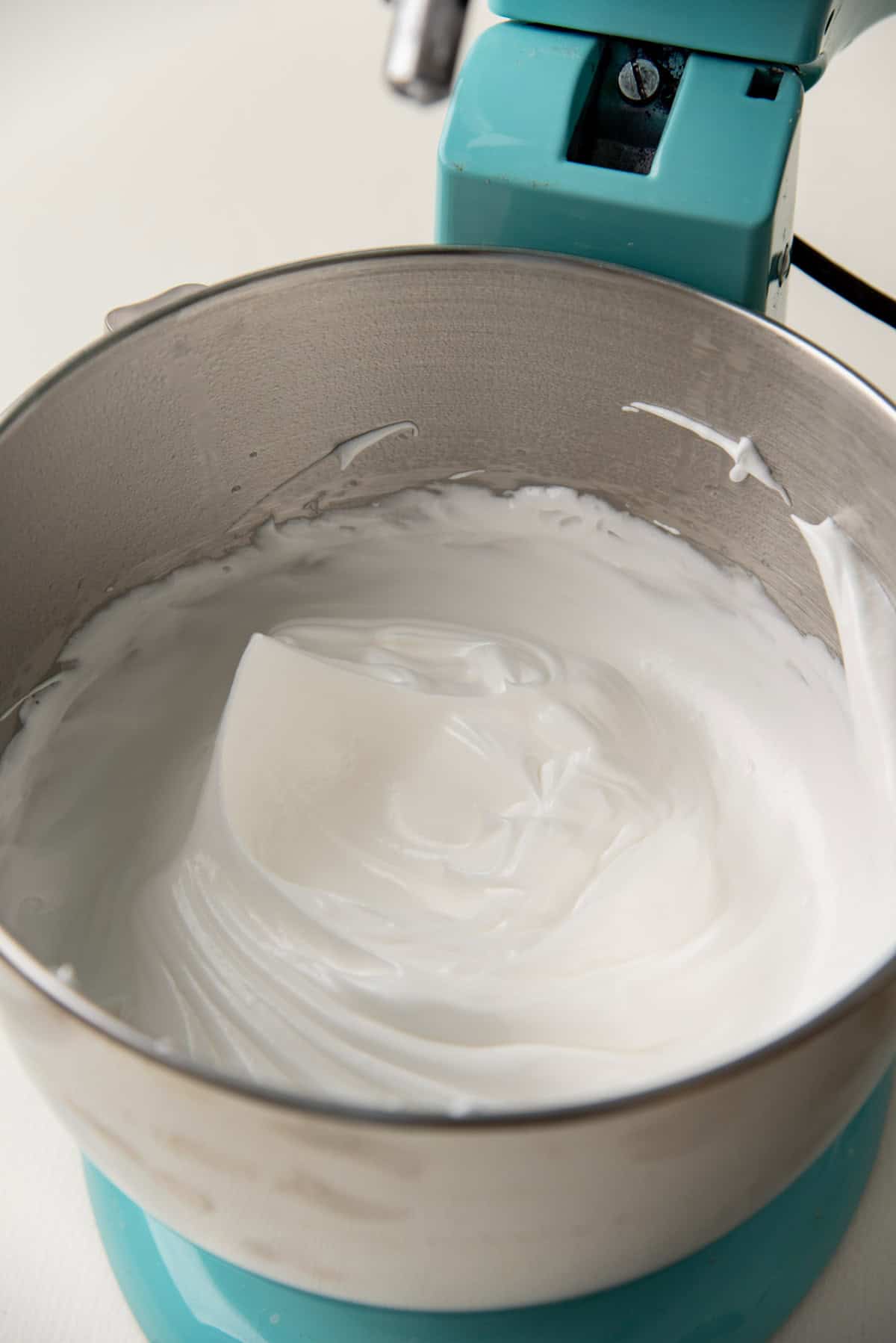
Place the mixing bowl in your stand mixer with the whisk attachment (image 8) . Whisk the meringue until it reaches stiff peaks (image 12) .
The meringue will go through a few different stages. To test these stages, it’s important to just have enough meringue on the whisk to create a small peak.
Soft peaks (image 10) – At this stage the meringue is foamy but holds no peaks. When you pick up the whisk, the meringue droops to the side.
Firm peaks (or mid peaks or medium peaks) (image 11) – This stage is between soft and stiff peaks. The meringue will form a peak at the tip, but it still droops a little, at about a 90 degree angle.
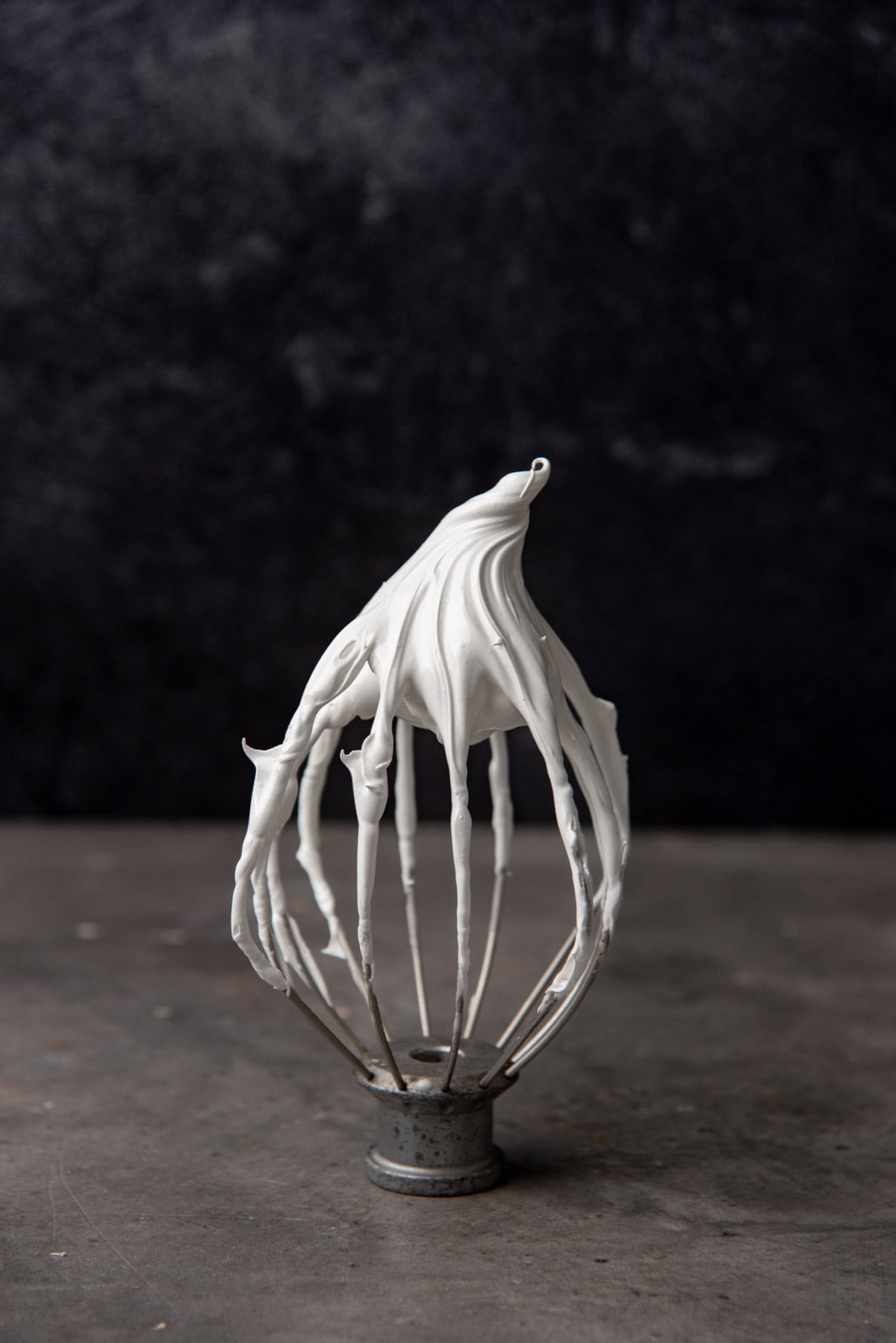
Stiff peaks (image 12) – This is what we want to achieve. The peak on the meringue stays up and doesn’t droop. The meringue is thick and glossy.

Check the consistency of the meringue from time to time, so you know at what stage you are. Overwhisking is rare (because of the sugar that we add), but it can still happen and the peak will go from stiff back to soft peaks!
When the meringue is at firm peaks, add the vanilla extract or vanilla beans.
Step 6 – The meringue is ready to be used
Swiss meringue will be stable for a little while, but I recommend using it as soon as you can. Swiss meringue will pipe beautifully as well, so it can be transferred to a piping bag too.
Ways to use swiss meringue
This Swiss meringue is a cooked meringue heated to a food safe temperature! So it’s safe to use this for many applications where the meringue won’t be cooked.
Use it as a topping for your pies, like this lemon meringue pie or lemon meringue pie cocktail .

This meringue is also great as a cake frosting .
Baked alaska or bombe alaska also uses swiss meringue.
Swiss meringue can be torched with a kitchen torch or under the broiler in the oven to get a nice caramelized surface.
Variations
Instead of vanilla extract you can also use other extracts as well.
Make sure they are alcohol-based extracts and not emulsions or fat-based extracts.
- Lemon or any citrus extract
- Almond extract
- You can also sieve and fold in freeze dried fruit powders for a fruity swiss meringue ! Like raspberry swiss meringue, passion fruit swiss meringue etc.
- To make chocolate swiss meringue , sift and fold in cocoa powder. However, make sure to use 0% fat cocoa powder, as cocoa powder with higher fat content can destabilize the meringue and make it very hard to pipe.

What do to with leftover egg yolks?
Leftover egg yolks don’t store well by themselves. So, if you’re not using them immediately, you must store them properly.
This is how I like to store leftover egg yolks
Fill a 16 oz deli cup (or any airtight container) with cold water. There should be enough to submerge the yolks and to have at least 1/2 inch of water above the yolks.
Carefully place the (unbroken) yolks in the water. Then close the container and keep it in the fridge for up to 2 days.
What you can do with leftover egg yolks
You can make many delicious recipes with the egg yolks!
- Lemon curd
- Lemon meringue pie (use the yolks for the lemon filling, and the egg whites for the topping)
- Passion fruit meringue pie (use the yolks for the passion fruit filling, and the egg whites for the topping)
- Homemade banana pudding (my favorite use of egg yolks!)
- Caramel banana cream pie
- Pastry cream
- Creme chiboust (the yolks are used to make the custard base, and the egg whites are folded into the custard)
- Cured egg yolks
- Pasta carbonara

Why won’t my meringue form stiff peaks?
Maybe the meringue is almost at stiff peaks, but it just wont get to stiff peaks. Or it just wont pass beyond soft peaks? Fat is ALWAYS the culprit . This is why we have to take every single precaution to ensure there is no fat contamination. Even if the bowl you used to measure sugar had some butter or oil, this will get into the egg whites and prevent stiff peaks from forming. If you had a meringue with stiff peaks that deflated after using a spatula or spoon, then unfortunately the spatula or spoon contained fat that disrupted the meringue structure. Fat molecules will disrupt the matrix that the egg proteins create to make a stable meringue foam. Even a small disruption can cause a chain reaction and destabilize the whole meringue foam.
Why has my meringue curdled?
This happens when the meringue is over-whisked. With the right amount of sugar, the occurrence of curdling isn’t very common. But if you reduced the amount of sugar and whisked the meringue too long, this can lead to a lumpy, curdled, dry looking meringue. The egg whites can also curdle during the heating step. To prevent this, it’s important to keep the egg white mixture moving constantly with a whisk. This helps to evenly distribute the heat and prevent the egg white from cooking and setting.
Can I make this ahead of time?
Unfortunately, no. Meringue cannot be made ahead of time to be used later. Since swiss meringue is not baked, the foam will destabilize with time. Swiss meringue can still be useable for up to about an hour, but the meringue will start to dry out and look lumpy as it sits. So, I recommend using the meringue as soon as you can after making it. It will be smoother, glossier, and more stable for piping. That being said, if you top your pie with swiss meringue, then this can stay for a few hours! Already piped meringue will be OK for a few hours!
Can I double or halve this recipe?
Yes! This recipe is for 4 large egg whites. But you can also make it with 1 egg white. However, you may not be able to use a stand mixer for smaller amounts, and will have to use an electric hand mixer instead. You can also double the recipe, as long as your mixer can handle the amount of meringue it will create. For a standard mixer, I don’t recommend making swiss meringue from more than 6 egg whites. Remember that egg whites have the capacity to expand up to 8 times in volume!
Can you bake swiss meringue?
You can! I usually only bake French meringue to make meringue cookies, but Swiss meringue can be baked as well. Bake it at a low temperature to ensure that the meringue dries out slowly. Unlike French meringue, Swiss meringue does not expand as much when baked. The shape and piping are more visible for this reason, and it’s great for baked meringue decorations.
Can I use boxed egg whites?
Yes, you can use carton egg whites to make meringue as well. The boxed liquid egg whites are pasteurized, so you don’t have to heat it to 170 F. Just heat the egg whites with the sugar until 140 – 150 F, until the sugar dissolves. Then proceed with the recipe. The most important tip I can give you is to properly measure the liquid egg whites. 30 g or 30 mL per egg white, and use the right amount of sugar as well.
More baking how-to recipes and tutorials
- Perfect choux pastry
- How to make perfect pie crust
- Perfect classic eclairs
- Foolproof pastry cream recipe
- How to make pavlova
- Shortcrust pastry (pâte sucrée basics)
- Homemade French croissants
- Classic pound cake
- Homemade marshmallows
- How to make doughnuts
Recipe
Perfect Swiss Meringue (Stable, Safe To Eat)
Ingredients
- 120 mL egg whites ½ cup (about 4 egg whites from large eggs)
- 200 g white sugar 1 cup
- ½ tsp cream of tartar
- ¼ tsp fine sea salt
- 10 mL vanilla bean extract optional, 2 tsp
Instructions
Preparing the bowls and utensils
- I recommend that you use meal bowls and whisks to make the meringue. Clean and dry all the bowls that contain the egg whites and the sugar to prevent any fat residue from being introduced into the meringue.
- Optional step - Soak a clean paper towel (partially) with white vinegar. Wipe the bowls, utensils, and whisks with white vinegar and let them dry out. The acidity of vinegar will help clean the bowls thoroughly and remove any oil / fat residue.
- If you’re whisking egg whites by hand, then I recommend using a large balloon whisk to make it easier to form meringue.
Separate the egg whites
- Carefully separate the egg whites from the large eggs. I recommend that you separate one egg at a time into a smaller bowl, and then transfer the egg white into the mixer bowl. This way, if 1 egg white gets contaminated with a broken yolk, then the other egg whites are still safe. 120 mL egg whites
- Place all the egg whites in the mixer bowl, and add the cream of tartar, salt, and the sugar. Whisk to combine. 200 g white sugar, ½ tsp cream of tartar, ¼ tsp fine sea salt
Cooking the egg sugar mixture
- Use a medium-sized pot where the mixing bowl can comfortable sit on top without touching the bottom of the pot. Fill the pot with about 2 - 3 inches of water.
- Heat the water over medium high heat on your stove and bring it to a simmer. Lower the heat to maintain the simmer.
- Place the mixer bowl with the egg whites over the pot with the simmering water.
- Using the whisk, stir to continuously move the egg whites while heating it over the double boiler. This will prevent the egg whites from cooking and scrambling.
- Heat the egg white mixture until the egg white mixture reaches between 170 - 175°F / 77 - 79°C. This can take about 10 minutes, depending on the stove and mixer bowl. (If you need to stop stirring the egg whites, then remove the bowl from the double boiler until you’re ready to start stirring again.)
Whisking the meringue
- Remove the bowl from the double boiler, and place it in your stand mixer with the whisk attachment.
- Whisk the egg mixture on medium high speed until you reach stiff peaks. Stop whisking periodically, and take a little of the meringue with the tip of the whisk to create a small peak of meringue. Then check the peak for the consistency of the meringue. See post for more details and reference pictures.
- The meringue will first reach soft peaks, where the tip will be very droopy. Then it will reach mid peaks, where the meringue will form a peak that will droop slightly at the tip. And then finally reach stiff peaks, where the meringue will form a peak that stays straight up.
- Add the vanilla after the meringue has reached mid peaks, so it has about 1 - 2 minutes to mix through the meringue. 10 mL vanilla bean extract
- When the meringue has reached stiff peaks, it’s ready to be used immediately for best results. Make sure that any spatulas that will be used are also free of any fat residue as this will cause the meringue to collapse and lose its structure.
Notes
Nutrition
Recipe from The Flavor Bender by Dini Kodippili
Perfect Swiss Meringue (Stable, Safe To Eat) https://www.theflavorbender.com/perfect-swiss-meringue-recipe/
