This Lychee Cocktail with Raspberry Caviar (A delicious caviar cocktail made with Molecular Gastronomy) is guaranteed to blow the socks off of your guests no matter what the occasion!
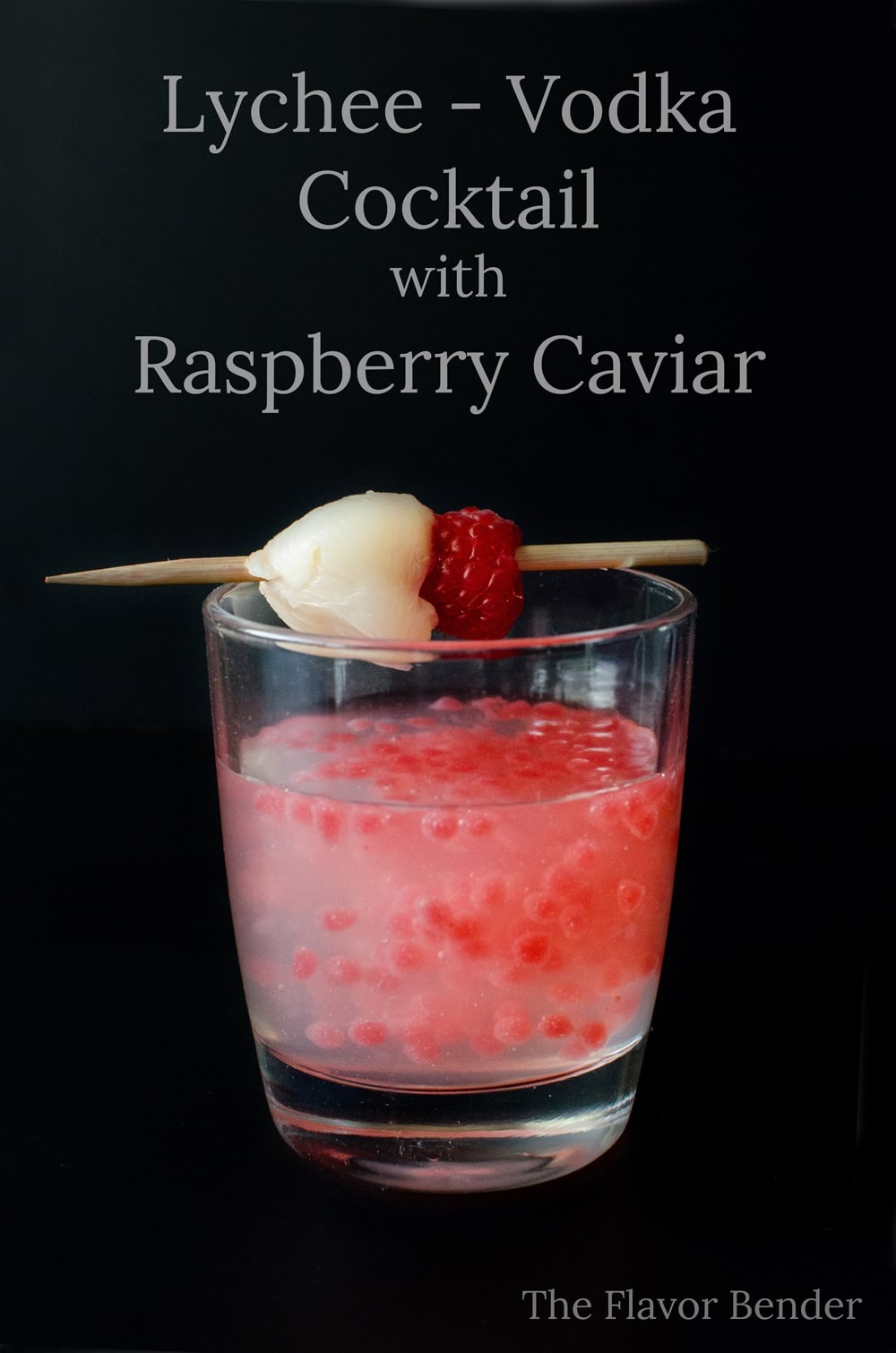
Caviar cocktails with molecular gastronomy
I’m sure many of you have heard of Molecular Gastronomy before. Especially if you’re delirious about food the way I am! It used to be something that only cool kids in the food world like Heston Blumenthal (the genius behind The Fat Duck), got to play with.
He is the reason why I too became familiar with it several years ago and since then I’ve been experimenting with it every chance I get. I’ve been wanting to introduce my readers to the wonders of Molecular Gastronomy for a while now. That moment has finally arrived! 🙂
What is molecular gastronomy?
Basically, it’s the study of chemical and physical processes that take place while cooking, how ingredients and food behave under different physical conditions such as temperature and pressure and using this knowledge to put an exciting spin on everyday food!
It’s the ultimate way to play around with flavors and textures and naturally, I absolutely LOVE the idea of it and all of the possibilities that come with it!
The term Molecular Gastronomy however makes it sound intimidating and inaccessible (like Heston Blumenthal says), when it isn’t.
Modernist cuisine or experimental cuisine also refers to basically the same idea, and if you’re someone with an adventurous streak when it comes to your food, you will no doubt love all the possibilities that this type of cuisine affords us.
I first started playing around with molecular gastronomy when I used to live in Australia, where the resources to get the additives required were quite limited in Lismore, where I used to live.
But here in the US, there are several places where you can get all of these additives and one such place is Molecule-R!
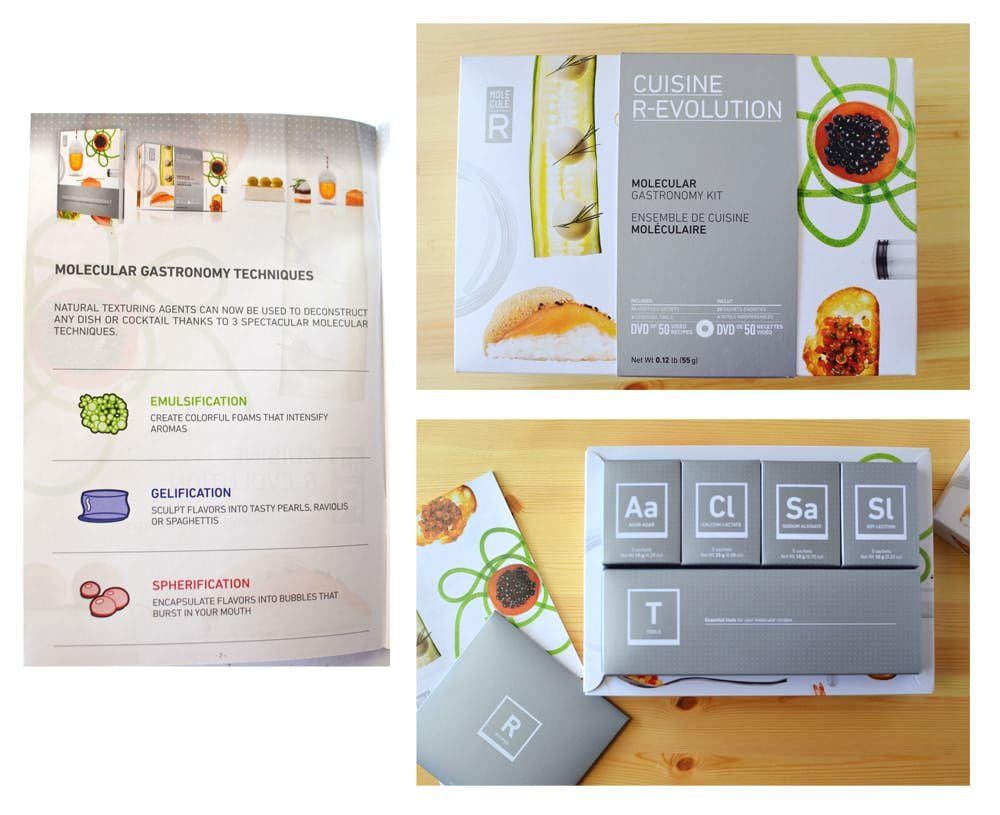
You can check out all of their kits online, on their website. These are the PERFECT, easy to use kits for those of you who have never tried Molecular Gastronomy before!
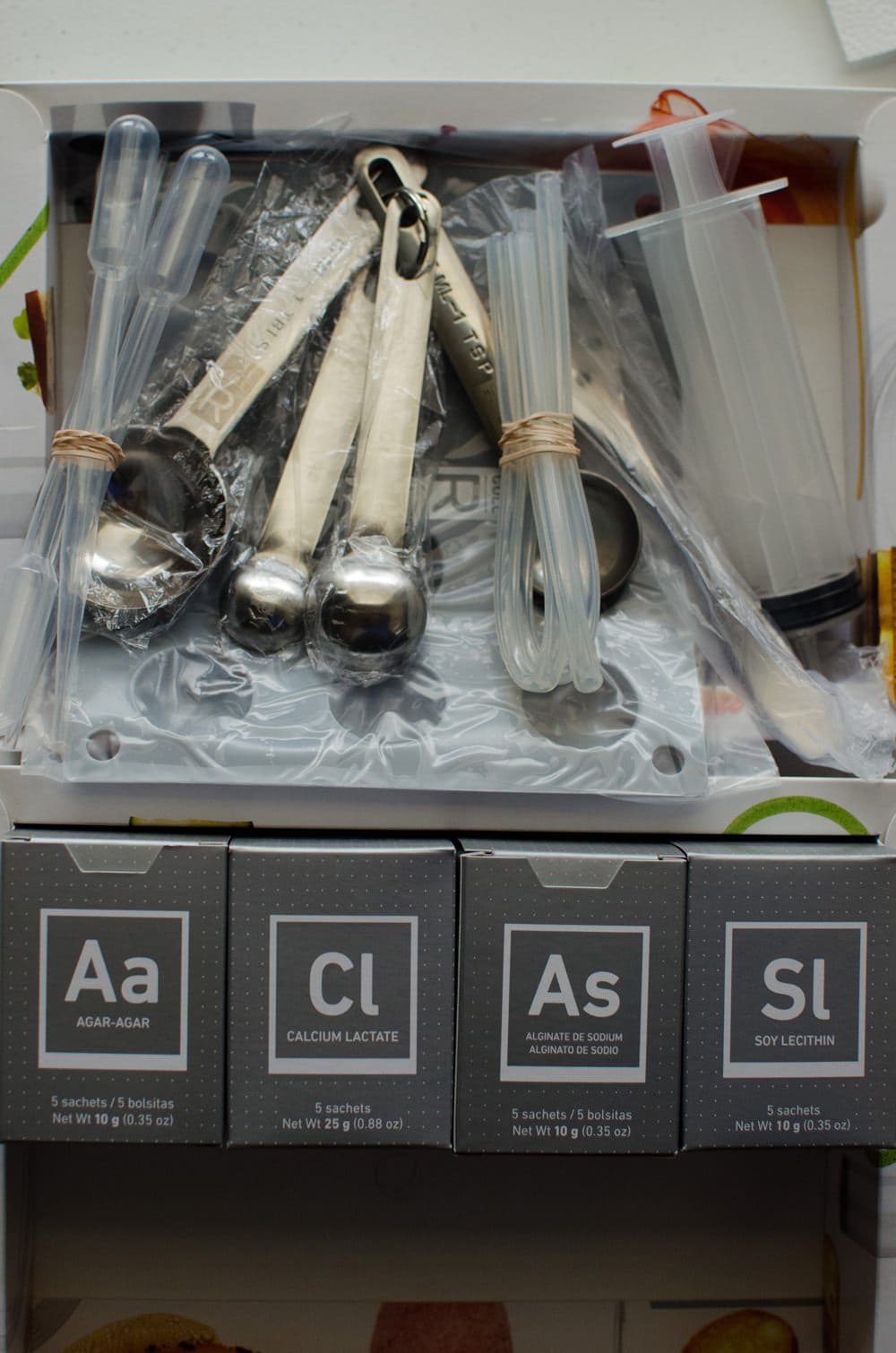
Starting with a Molecule-R kit to learn molecular gastronomy
They have all kinds of kits for different purposes (Cuisine R-Evolution, Cocktail R-Evolution and many more!).
Each kit comes with specific recipes that you can use the additives for, PLUS it also teaches you how they work, so you can become creative with them too! (The kit comes with all the additives, the tools you need, a booklet & a DVD).
The beginners Cuisine R-Evolution kit that I’m using here, gives you almost EVERYTHING you need to create beautiful, imaginative creations. Note – you do need to have an immersion blender or a GOOD high powered blender to mix some of the additives into the solutions.
PLUS, I also used Xanthan gum for some of my recipes, which is an additive that you should easily be able to find in the gluten-free section at your local supermarket/grocery store, or specialty stores that sell gluten-free ingredients).
Xanthan requires powerful shearing action to be blended into a liquid properly – An immersion blender or a good high powered blender will do the trick!.
Since the additives come in individual packets, you don’t have to measure out anything. You just measure out the liquid, rip the packet of the additive you require and just add it.
It’s really quite brilliant and foolproof, you will end up making a fairly large amount of caviar.
The one downside with these kits is that they are a little pricier than buying individual bags for different additives. That is to be expected though, because if you buy individual bags for separate additives you will have to measure things out.
Which means you will also have to invest in a small digital scale (like a chemical scale – I have one which I bought in Australia, and it’s ONLY used for weights up to 1lb with a 0.1g accuracy).
With these kits though, you don’t need to measure things out because they have all been PRE-WEIGHED for your convenience.
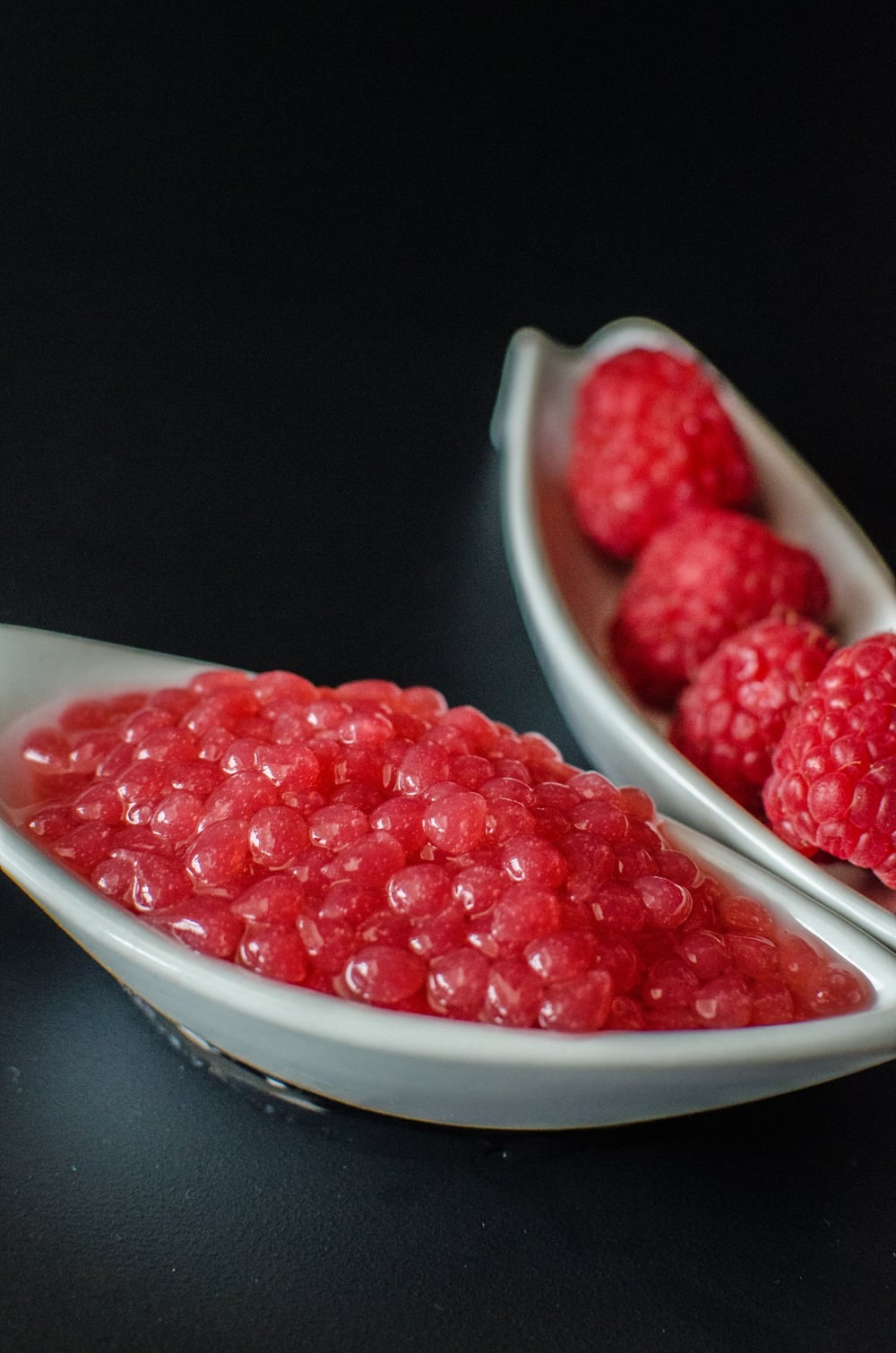
Raspberry caviar to make inventive caviar cocktails
All about this lychee cocktail (caviar cocktail)
With this Lychee Cocktail with Raspberry Caviar, I’m going to show you just how cool and impressive your cocktails can look and be!
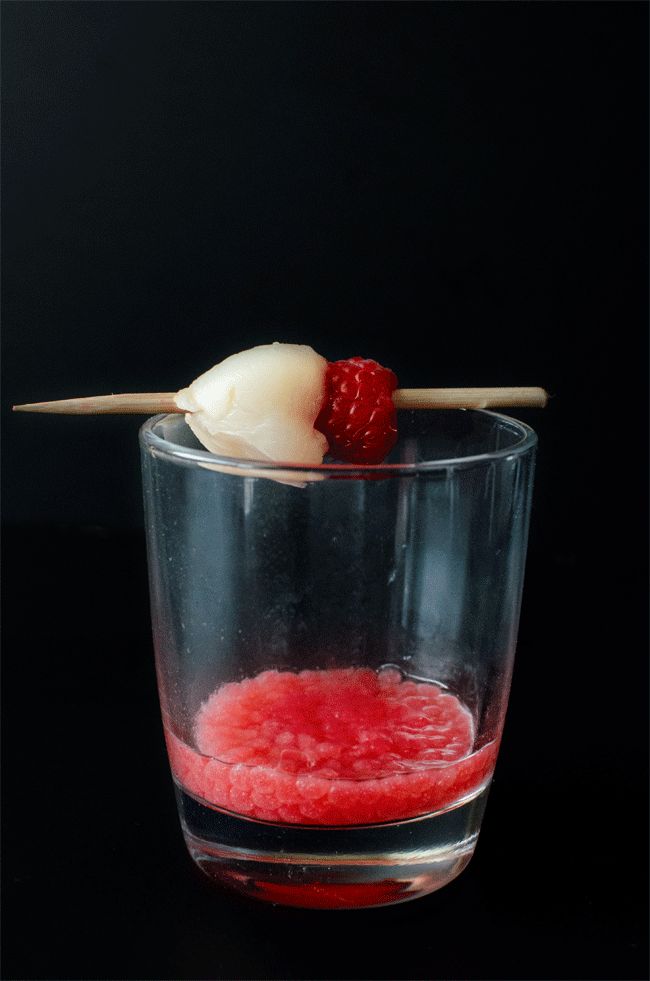
This is a delicious Lychee Vodka suspension that holds little raspberry caviar pearls that burst in your mouth and flood it with raspberry flavour as you sip your cocktail!
For this cocktail, you will be using two molecular gastronomy techniques.
- Thickening of the lychee cocktail suspension using Xanthan Gum . 2) Basic Spherification ( Sodium Alginate and Calcium Lactate ) to make the raspberry caviar.
Before I get to the recipe, just a few tips on Basic Spherification first.
Basic spherification
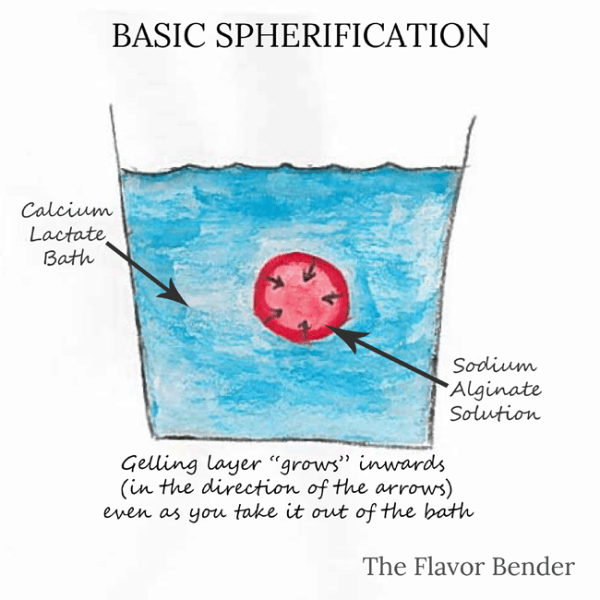
Spherification is caused by the reaction between Calcium molecules and Sodium alginate molecules. Calcium molecules get trapped between the Sodium alginate molecules forming a “gel layer”.
There are two main types of spherification – Basic and Reverse.
In Basic Spherification,
A flavoured base with sodium alginate is dropped into a calcium lactate bath. The sodium alginate reacts with the calcium to form a gel layer.
It forms a thin membrane that bursts readily in your mouth (when served as soon as it’s prepared, or at least within 15 minutes).
The longer it’s kept without being eaten, the liquid center of these spheres becomes smaller and smaller. This is because the gelling process continues towards the center, making it more like a chewy gel, rather than a delicate sphere that bursts in your mouth (I call this process inward gelification, to make it easier to remember).
So ideally, the spheres/caviar need to consumed within 15 minutes of preparation.
This is not too time consuming, since the bath and solution are ready to be used in an hour. Reverse spherification on the other hand requires a 24 hour resting time.
This method DOES NOT WORK with acidic solutions (very low pH solutions). This can be rectified by adding another additive to neutralize the acidity (Sodium Citrate), but this is not included in the kit.
Sodium alginate is a thickener. It will thicken the solution that it’s added to. But since it’s not too soluble, it requires agitation (by means of a blender or immersion blender) to disperse and dissolve.
As a result of this agitation, air bubbles will form, so you need to let it rest a little bit before being used.
It is important to use DISTILLED water, tap water may (most-likely) have free-floating Ca ions. If there is calcium in the solution that you are using to dissolve Sodium Alginate, that solution will gelify!
If you want to store the caviar, you can store it in the same solution that it was made in minus the sodium alginate. If you keep it in water, the flavour will dilute (as a result of osmosis).
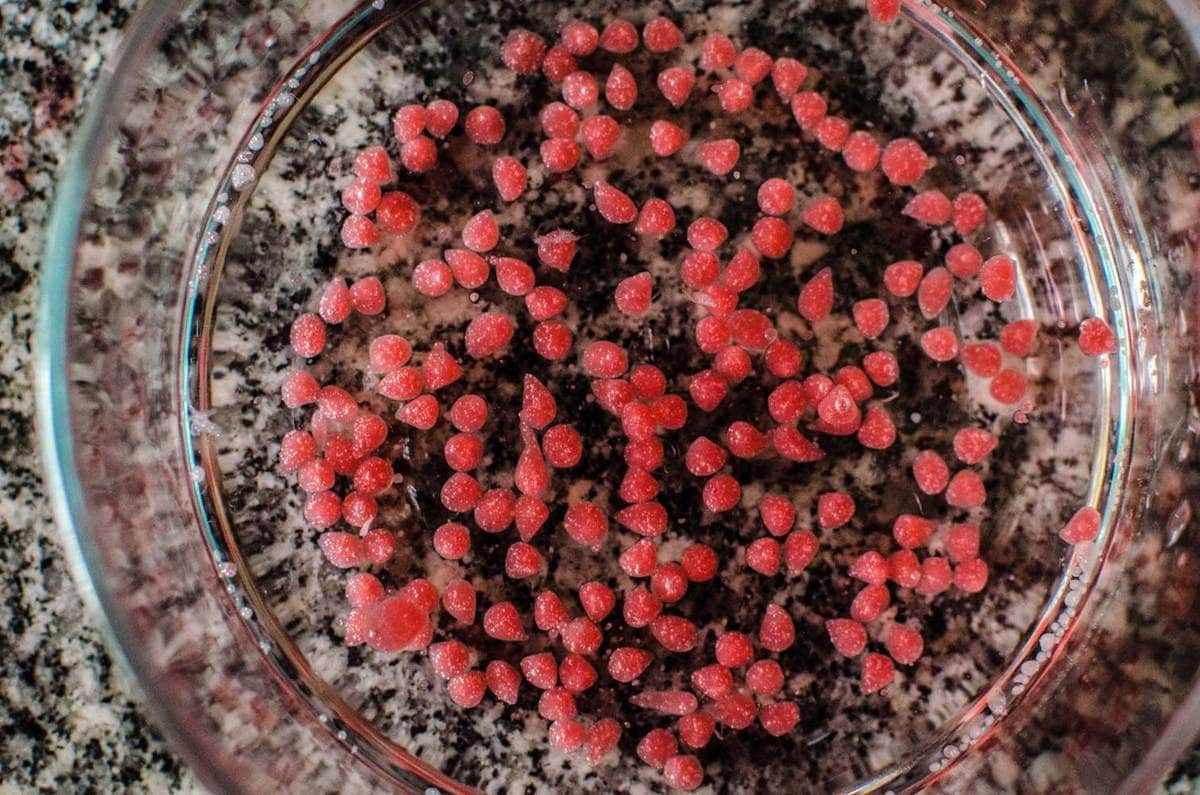
Raspberry Caviar sitting in the Calcium Lactate solution
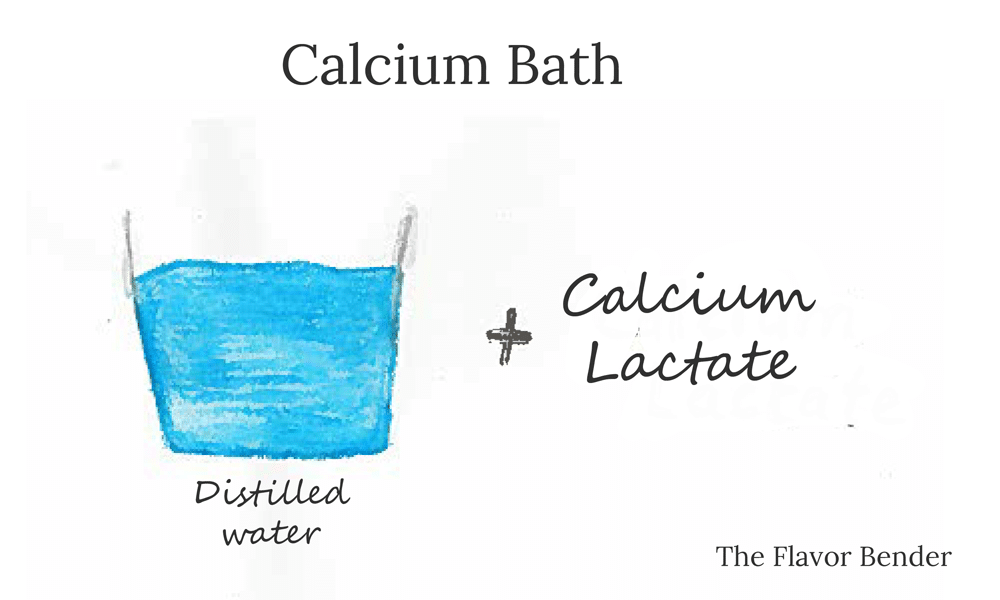
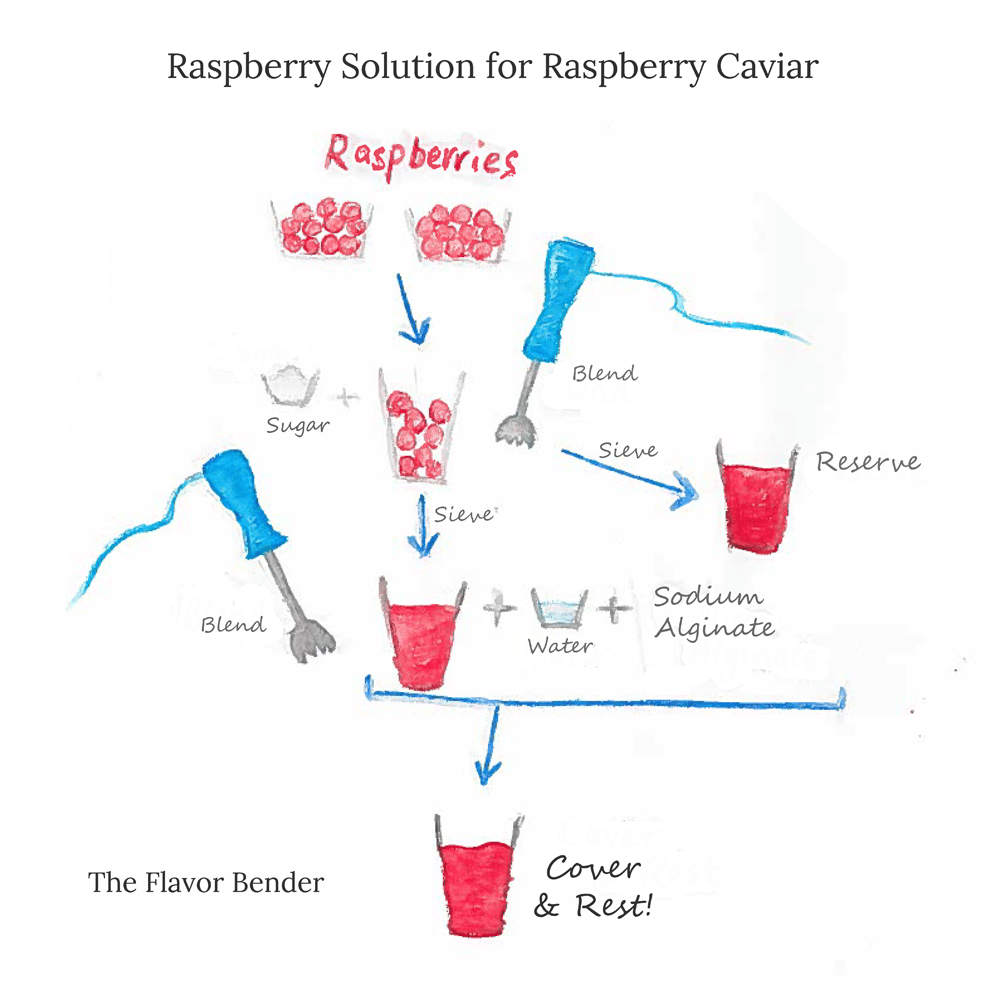
Here are some info-graphics to help you understand the method.

Recipe notes
And what’s the verdict on the lychee cocktail? I LOVED it! 🙂 And I’m sure you will too! I was afraid the suspension could be a little thick – but it was NOT!
This caviar cocktail tasted very smooth, and with the raspberry caviar you get these intense pockets of flavour, when they burst in your mouth. It’s not just a cocktail, it truly is an experience.
Imagine how bowled over your guests would be when you serve these?? Best way to get the better of those hard-to-impress, grouchy guests that we all have to deal with at some point or the other! 😀
More molecular gastronomy inspired recipes
You can find the SECOND recipe I made using this kit – white chocolate panna cotta right here.
And the THIRD recipe – black pepper infused spicy margarita spheres recipe.
And for more delicious lychee recipes, check out this coconut lychee orange jelly , lychee cantaloupe popsicles , ginger lychee sangria blanca , homemade lychee syrup , and this refreshing lychee mocktail !
Recipe
Lychee Cocktail with Raspberry Caviar (Caviar Cocktail)
Ingredients
Lychee Cocktail Suspension
- 2 cans of lychee you need 400mL / 13.5 fl oz of lychee syrup
- 300 mL Vodka
- ¼ tsp Xanthan gum
- Extra sugar syrup or caster sugar, if needed
Raspberry solution
- 340 g /12 oz of Raspberries fresh or frozen (that have been thawed)
- 4 - 6 tbsp white sugar
- 100 ml /3.3 fl oz DISTILLED water
- 1 packet of Sodium Alginate 2g
Calcium Lactate bath
- 4 cups of DISTILLED water
- 1 packet of Calcium Lactate 5g
Instructions
Lychee cocktail suspension (prepare this a day ahead)
- Drain the Lychee from the lychee can. Set the lychees aside to garnish the drink later.
- Measure 400mL / 13.5 fl oz of the lychee syrup and mix it with the vodka.
- Sprinkle in the Xanthan gum, and using a blender or immersion blender, blend the mix until the Xanthan gum has completely dissolved and thickened the drink. Blend it in pulses for about 3 minutes. Pour into a bottle or jug, cover and chill overnight.
To make the Raspberry Caviar solution
- Pulse the raspberrries (using blender or immersion blender) with 6 tbsp of sugar until it’s liquefied. Strain the liquid to remove the seeds.
- Measure 150mL / 5.1 floz of the raspberry puree and mix it with 100mL / 3.3 floz of distilled water.
- Sprinkle 1 packet of Sodium Alginate and blend it for about 10 minutes (intermittently) to completely dissolve the additive. You can use your (dry) blender or (dry) immersion blender to do this. Sodium Alginate requires agitation to dissolve, therefore the longer you go, the better it will dissolve and disperse.
- Cover the solution and let it rest for about an hour in the fridge till you’re ready to use.
Calcium Bath
- In 4 cups (about 1 liter) of distilled water, sprinkle in 1 packet of Calcium Lactate and stir to dissolve. Calcium lactate is water soluble, so it can be stirred to dissolve completely.
- Set aside for about 15 minutes (or more), covered, till you’re ready to use.
Assembly
- Set up two bowls - One for the Calcium bath and another for clean distilled water.
- Stir the raspberry solution gently just before use, and then use the pipette (from the kit) to drop the solution into the calcium bath, one small drop at a time. Drop the solution from a height of about an inch from the surface of the calcium bath. The droplets should sink to the bottom. You can use the strainer spoon to swirl the caviar in the bath. Leave it for about 1 minute.
- Strain the caviar out of the calcium bath (using the supplied spoon) and transfer to the water bath. Then from the water bath to the glasses that you will be serving the cocktail.
- The caviar can be stored for about 15 minutes, after which it will completely gelify and will no longer have a liquid center.
- Once you have about 1 - 2 tbsp of caviar in each of the glasses (1 tbsp for shot glasses), top it with the lychee cocktail suspension.
- Serve immediately with a lychee and raspberry garnish!
Notes
Recipe from The Flavor Bender by Dini Kodippili
Lychee Cocktail with Raspberry Caviar (Caviar Cocktail) https://www.theflavorbender.com/lychee-cocktail-with-raspberry-caviar/
This Lychee Cocktail with Raspberry Caviar (A delicious caviar cocktail made with Molecular Gastronomy) is guaranteed to blow the socks off of your guests no matter what the occasion!
Caviar cocktails with molecular gastronomy
I’m sure many of you have heard of Molecular Gastronomy before. Especially if you’re delirious about food the way I am! It used to be something that only cool kids in the food world like Heston Blumenthal (the genius behind The Fat Duck), got to play with.
He is the reason why I too became familiar with it several years ago and since then I’ve been experimenting with it every chance I get. I’ve been wanting to introduce my readers to the wonders of Molecular Gastronomy for a while now. That moment has finally arrived! 🙂
What is molecular gastronomy?
Basically, it’s the study of chemical and physical processes that take place while cooking, how ingredients and food behave under different physical conditions such as temperature and pressure and using this knowledge to put an exciting spin on everyday food!
It’s the ultimate way to play around with flavors and textures and naturally, I absolutely LOVE the idea of it and all of the possibilities that come with it!
The term Molecular Gastronomy however makes it sound intimidating and inaccessible (like Heston Blumenthal says), when it isn’t.
Modernist cuisine or experimental cuisine also refers to basically the same idea, and if you’re someone with an adventurous streak when it comes to your food, you will no doubt love all the possibilities that this type of cuisine affords us.
I first started playing around with molecular gastronomy when I used to live in Australia, where the resources to get the additives required were quite limited in Lismore, where I used to live.
But here in the US, there are several places where you can get all of these additives and one such place is Molecule-R!
You can check out all of their kits online, on their website. These are the PERFECT, easy to use kits for those of you who have never tried Molecular Gastronomy before!
Starting with a Molecule-R kit to learn molecular gastronomy
They have all kinds of kits for different purposes (Cuisine R-Evolution, Cocktail R-Evolution and many more!).
Each kit comes with specific recipes that you can use the additives for, PLUS it also teaches you how they work, so you can become creative with them too! (The kit comes with all the additives, the tools you need, a booklet & a DVD).
The beginners Cuisine R-Evolution kit that I’m using here, gives you almost EVERYTHING you need to create beautiful, imaginative creations. Note – you do need to have an immersion blender or a GOOD high powered blender to mix some of the additives into the solutions.
PLUS, I also used Xanthan gum for some of my recipes, which is an additive that you should easily be able to find in the gluten-free section at your local supermarket/grocery store, or specialty stores that sell gluten-free ingredients).
Xanthan requires powerful shearing action to be blended into a liquid properly – An immersion blender or a good high powered blender will do the trick!.
Since the additives come in individual packets, you don’t have to measure out anything. You just measure out the liquid, rip the packet of the additive you require and just add it.
It’s really quite brilliant and foolproof, you will end up making a fairly large amount of caviar.
The one downside with these kits is that they are a little pricier than buying individual bags for different additives. That is to be expected though, because if you buy individual bags for separate additives you will have to measure things out.
Which means you will also have to invest in a small digital scale (like a chemical scale – I have one which I bought in Australia, and it’s ONLY used for weights up to 1lb with a 0.1g accuracy).
With these kits though, you don’t need to measure things out because they have all been PRE-WEIGHED for your convenience.
Raspberry caviar to make inventive caviar cocktails
All about this lychee cocktail (caviar cocktail)
With this Lychee Cocktail with Raspberry Caviar, I’m going to show you just how cool and impressive your cocktails can look and be!
This is a delicious Lychee Vodka suspension that holds little raspberry caviar pearls that burst in your mouth and flood it with raspberry flavour as you sip your cocktail!
For this cocktail, you will be using two molecular gastronomy techniques.
- Thickening of the lychee cocktail suspension using Xanthan Gum . 2) Basic Spherification ( Sodium Alginate and Calcium Lactate ) to make the raspberry caviar.
Before I get to the recipe, just a few tips on Basic Spherification first.
Basic spherification
Spherification is caused by the reaction between Calcium molecules and Sodium alginate molecules. Calcium molecules get trapped between the Sodium alginate molecules forming a “gel layer”.
There are two main types of spherification – Basic and Reverse.
In Basic Spherification,
A flavoured base with sodium alginate is dropped into a calcium lactate bath. The sodium alginate reacts with the calcium to form a gel layer.
It forms a thin membrane that bursts readily in your mouth (when served as soon as it’s prepared, or at least within 15 minutes).
The longer it’s kept without being eaten, the liquid center of these spheres becomes smaller and smaller. This is because the gelling process continues towards the center, making it more like a chewy gel, rather than a delicate sphere that bursts in your mouth (I call this process inward gelification, to make it easier to remember).
So ideally, the spheres/caviar need to consumed within 15 minutes of preparation.
This is not too time consuming, since the bath and solution are ready to be used in an hour. Reverse spherification on the other hand requires a 24 hour resting time.
This method DOES NOT WORK with acidic solutions (very low pH solutions). This can be rectified by adding another additive to neutralize the acidity (Sodium Citrate), but this is not included in the kit.
Sodium alginate is a thickener. It will thicken the solution that it’s added to. But since it’s not too soluble, it requires agitation (by means of a blender or immersion blender) to disperse and dissolve.
As a result of this agitation, air bubbles will form, so you need to let it rest a little bit before being used.
It is important to use DISTILLED water, tap water may (most-likely) have free-floating Ca ions. If there is calcium in the solution that you are using to dissolve Sodium Alginate, that solution will gelify!
If you want to store the caviar, you can store it in the same solution that it was made in minus the sodium alginate. If you keep it in water, the flavour will dilute (as a result of osmosis).
Raspberry Caviar sitting in the Calcium Lactate solution
Here are some info-graphics to help you understand the method.
Recipe notes
And what’s the verdict on the lychee cocktail? I LOVED it! 🙂 And I’m sure you will too! I was afraid the suspension could be a little thick – but it was NOT!
This caviar cocktail tasted very smooth, and with the raspberry caviar you get these intense pockets of flavour, when they burst in your mouth. It’s not just a cocktail, it truly is an experience.
Imagine how bowled over your guests would be when you serve these?? Best way to get the better of those hard-to-impress, grouchy guests that we all have to deal with at some point or the other! 😀
More molecular gastronomy inspired recipes
You can find the SECOND recipe I made using this kit – white chocolate panna cotta right here.
And the THIRD recipe – black pepper infused spicy margarita spheres recipe.
And for more delicious lychee recipes, check out this coconut lychee orange jelly , lychee cantaloupe popsicles , ginger lychee sangria blanca , homemade lychee syrup , and this refreshing lychee mocktail !
