
Slow roasting salmon is an easy and stress-free way to perfectly cook salmon for your whole family or even a crowd. This lemon slow roasted salmon with lemon butter sauce is creamy, juicy, flavorful and PERFECT for brunch, lunch OR dinner!
Slow roasted salmon is a simple but delicious way to prepare salmon.

What’s a dish that’s just as perfect for brunch, lunch OR dinner? This right here folks, this Slow Roasted Salmon served with a creamy Lemon Butter Sauce is as delicious as it is versatile!

Why you should be slow roasting salmon!
Slow roasting salmon is a game changer. It’s my favorite way to eat salmon because the flesh is PERFECTLY cooked, it’s buttery and melt-in-your-mouth delicious, and so simple to cook. Plus, you can season and baste the salmon with your favorite seasonings or marinade.
How to serve slow roasted salmon
This slow roasted salmon is flavored simply with some melted butter (brown butter is even better!), lemon, salt and pepper.
But the whole is so much greater than the sum of its parts in this dish, and the flavor of the salmon really comes to life.
I can’t get enough of how amazing this simple dish tastes!
I serve this lemon slow roasted salmon with an easy sauce made with the same flavors that I added to the salmon.
This creamy buttery lemon butter sauce has a nice lemony kick to it, and a good amount of garlic.
The dish is served with a side of pan-fried asparagus, red onions and a spring salad. An easy caprese salad with balsamic glaze or a quinoa salad or even a classic panzanella salad would be a lovely pairing.
It’s a great spring-time dish, with some simple ingredients, but big, bold flavors.

Why I love slow roasted salmon!
Another reason why I love slow roasting salmon is because it’s the perfect way to cook salmon for a crowd .
No longer do I have to pan fry salmon fillets one at a time and keep them warm till the rest are cooked. This way I can place all the salmon fillets in one sheet pan and cook them all together.

How I prep for this slow roasted salmon dish
I first start preparing the butter. I melt the butter (I actually make brown butter most of the time, but that’s optional). While the butter is melting, I prepare the salmon by pat drying it and cutting it into the sizes I want.
I usually cut it into 3 ounce pieces for smaller portions/lighter meals, and about 5-6 ounce pieces if I want to serve this dish as a main. Then I brush the salmon fillets with the melted butter, and season them and let them marinate for about 30 minutes.
While the salmon is marinating, I cut up all the vegetables and ingredients that I need. This includes chopping the garlic, shallots, red onion, asparagus and making sure the salad leaves are ready.
When the prepping is done, and the salmon is in the oven, it gives me just enough time to make the lemon butter sauce and to pan fry the asparagus.
That’s it! You can serve a family or a crowd with this delicious and impressive meal, and this way the buttery slow roasted salmon will be freshly cooked and warm, with minimal effort on your part.
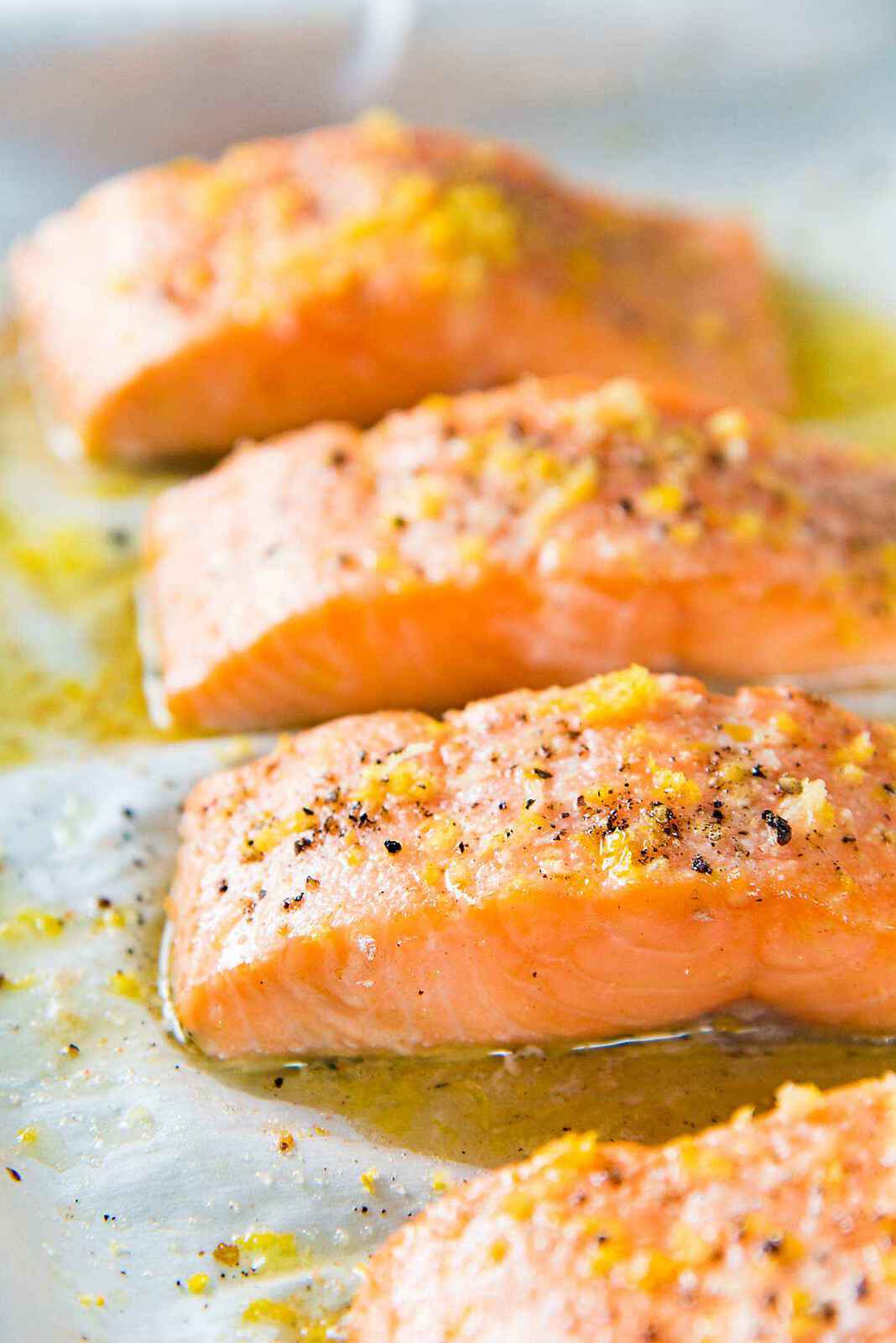
Why this recipe works
- The salmon is perfectly cooked. There’s really nothing better than soft, buttery, juicy salmon!
- The salmon cooks more evenly. Due to the low heat of the oven, the salmon cooks slowly and more evenly. While the edges might be SLIGHTLY more cooked than the middle, NO PART of the salmon is over-cooked or dry.
- This slow and low approach of cooking salmon is more flexible and more fool-proof , and is a very easy way to cook fish. Salmon (and other kinds of fish) are notorious for drying out quickly. While a pan-fried piece of salmon is so delicious, the high heat will either dry out the exterior and the edges of the salmon if it gets overcooked even slightly! But by slow roasting salmon, the salmon still tastes soft and juicy even if you end up overcooking it for 5 minutes! So it’s GREAT for beginners. 🙂
- You can flavor the salmon any way you want! Because of the low heat of the oven, the marinade and spices won’t burn. You can even add a glorious teriyaki glaze and the salmon will taste perfect with no burnt sugar bits or burnt garlic bits. But honestly, this simple lemon and butter marinade is my absolute favorite.
- This slow roasted salmon can be served hot, warm, at room temperature OR COLD ! And it even tastes SO GOOD the next day with some eggs and toast like this egg in a hole recipe.
Convinced? Good.

How to check if the salmon is done
If you have a food thermometer (or temperature probe), the salmon should be cooked to an internal temperature of 145°F (62°C). I ALWAYS use a food thermometer so that I get accurate results every time, but if you don’t have one, no worries.
This salmon is completely cooked through without being the least bit dry. I have on occasion let this salmon cook to about 155-160°F, and it STILL tastes incredibly juicy.
The only thing that you notice at that temperature is the white albumin that leaks out of the salmon. This is just coagulated protein, and while it’s totally harmless, it doesn’t look great.
But between you and me, it that does happen, you can easily wipe it off, and no one will know. 😉

You can check the doneness of your salmon by inserting a fork or a thin knife into the salmon. If it goes in easily, then it’s ready.
Another test is to gently press the top of the salmon, and if you feel like it’s just starting to flake, then it’s done. But the sure-fire way to get perfect, consistent results is with a temperature probe.
Can I still get crispy skin with this recipe?
If you are a crispy skin fan like me, you may start missing the crispy skin with this slow roasting technique. But there is a way to still get that delicious crispy skin if you really want to!
One option for that would be to sear the skin side on a very hot pan just before serving the salmon if you like.
Honestly though, this lemon slow roasted salmon is so buttery and flavorful, I never actually miss the crispy skin with this dish.
BUT, leftovers are a different matter! With leftovers, I separate the flesh from the skin and serve the flesh separately (and cold). Then I pan fry the salmon skin until it’s crispy and then it’s shredded and added as a topping. 🙂

So if you’re still wondering about how to slow roast salmon, you should definitely give this butter lemon slow roasted salmon a try! It’ll change the way you cook salmon for a family.
And after reading this post (and recipe) you will definitely learn how to make slow roasted salmon perfectly! Deliciously soft and juicy salmon with minimal stress and effort is something I can always get behind.

Other recipes you may like,
- Egg in a hole with salmon
- Ahi tuna poke bowl
- Fish cutlets (fish croquettes)
- Crispy fish tacos with roasted grapes
- Butter lobster risotto
- How to cook lobster
Equipment and tools I use for this recipe
- Half sheet pan – to roast the fish fillets. I do like to line the pan with parchment paper so that cleaning up will be easier.
- Pastry brush – to brush on the butter on the Salmon fillets
- Cooking thermometer to help check internal temperature
Recipe
Slow Roasted Salmon with Lemon and Butter Sauce
Ingredients
Slow Roasted Salmon
- 340 g fresh salmon fillets (cut into 4 ) Belly cut. 4 x 3 oz salmon fillets. Please see NOTES for larger portions
- 60 mL melted butter ¼ cup or melted brown butter
- Sea salt
- 1 lemon juice (about 3 - 4 tbsp)
- 1 tbsp lemon zest (from 1 lemon)
- Freshly cracked black pepper
Lemon Butter Sauce
- 60 mL melted butter ¼ cup or melted brown butter
- 2 tbsp lemon juice about ½ lemon
- ½ shallot minced
- 2 garlic cloves minced
- 2 tbsp water or white wine
- 1 tbsp heavy cream 35% fat minimum
- Salt
- ½ tsp sugar
- ½ tbsp chopped dill
- ½ tbsp chopped parsley
Pan-fried Asparagus
- 450 g asparagus 1 lb. woody ends chopped
- 1 tbsp oil / butter
- 3 tbsp drained capers
- ½ tbsp chili flakes optional
- salt to taste
- ½ medium red onion thinly sliced
To Serve
- Spring salad mix
Instructions
Slow Roasted Salmon
- When you buy the salmon, make sure to get 12 oz (or more) of the center belly cut of salmon , so you have evenly-sized salmon pieces. Pat dry the salmon, and cut it evenly into 4 portions that weight about 3 oz each (for light meals). See notes for preparing salmon for dinner, or as a larger meal. 340 g fresh salmon fillets (cut into 4 )
- Preheat oven to 250°F. Line a baking tray with parchment paper and brush the bottom with the melted butter (or brown butter). Sprinkle the buttered parchment paper with a little salt (where you would place the salmon). Place the salmon pieces on the tray with at least 1 - 1 ½ inches of space between each piece. Sea salt, 340 g fresh salmon fillets (cut into 4 )
- Generously brush the top and sides of the salmon pieces with butter. Drizzle some lemon juice (about ½ - 1 tbsp per piece) over the salmon, followed by some sea salt. 60 mL melted butter, 1 lemon, Sea salt
- Place the salmon in the preheated oven and set the timer to 10 minutes. Cook time may vary between 12 - 20 minutes, depending on the thickness and weight of the salmon. Prepare the lemon butter sauce and asparagus while the salmon is cooking.
- Check the doneness of your salmon after 10 minutes. A fork or thin sharp knife inserted into the thickest part of the salmon should go in easily with no resistance if it’s done. OR you can check the internal temperature of the salmon - if it’s 145°F, then it’s done. Check every few minutes after the 10 minute mark. If the surface looks translucent, don’t worry. The salmon is still perfectly cooked.
- When the salmon is cooked, remove from the oven and brush the top with a little more butter (optional), and sprinkle some black pepper, and zest some lemon on top. Let the salmon rest for a few minutes. Freshly cracked black pepper, 1 tbsp lemon zest
Lemon Butter Sauce
- Finely chop the garlic and shallots. ½ shallot, 2 garlic cloves
- In a small saucepan, combine the melted butter and lemon juice with the garlic and shallots. Bring the mix to a simmer over medium-high heat, while whisking. Whisk until the sauce has emulsified. 60 mL melted butter, 2 tbsp lemon juice
- Once the the mix is emulsified and the shallots and garlic have softened, add the sugar, water/white wine and cream. Season with salt to taste. Whisk until the sauce comes to a simmer. Remove from the heat and stir in the dill and parsley. The sauce is now ready to be served. 2 tbsp water, 1 tbsp heavy cream, Salt, ½ tsp sugar, ½ tbsp chopped dill, ½ tbsp chopped parsley
Asparagus
- Cut the asparagus spears in half or into 3 pieces. Place a large non-stick pan over medium-high heat with the butter or oil. 450 g asparagus, 1 tbsp oil / butter
- When the butter / oil is hot, add the asparagus, capers and sprinkle with a generous pinch of sea salt. Leave the asparagus in the hot pan for 2 - 3 minutes to slightly char them. Add the chili flakes and red onions and toss to combine. Remove from the heat. 3 tbsp drained capers, ½ tbsp chili flakes, salt to taste, ½ medium red onion thinly sliced
Serving
- Place the asparagus on a serving platter, and carefully place the salmon over the asparagus (the salmon is very fragile, so use a spatula to move them). Sprinkle more chopped herbs (dill, parsley, or chives) on top.
- Serve with a spring salad and the lemon butter sauce on the side. Spring salad mix
Notes
Nutrition
Recipe from The Flavor Bender by Dini Kodippili
Slow Roasted Salmon with Lemon and Butter Sauce https://www.theflavorbender.com/slow-roasted-salmon-lemon-butter-sauce/
Slow roasting salmon is an easy and stress-free way to perfectly cook salmon for your whole family or even a crowd. This lemon slow roasted salmon with lemon butter sauce is creamy, juicy, flavorful and PERFECT for brunch, lunch OR dinner!
Slow roasted salmon is a simple but delicious way to prepare salmon.
What’s a dish that’s just as perfect for brunch, lunch OR dinner? This right here folks, this Slow Roasted Salmon served with a creamy Lemon Butter Sauce is as delicious as it is versatile!
Why you should be slow roasting salmon!
Slow roasting salmon is a game changer. It’s my favorite way to eat salmon because the flesh is PERFECTLY cooked, it’s buttery and melt-in-your-mouth delicious, and so simple to cook. Plus, you can season and baste the salmon with your favorite seasonings or marinade.
How to serve slow roasted salmon
This slow roasted salmon is flavored simply with some melted butter (brown butter is even better!), lemon, salt and pepper.
But the whole is so much greater than the sum of its parts in this dish, and the flavor of the salmon really comes to life.
I can’t get enough of how amazing this simple dish tastes!
I serve this lemon slow roasted salmon with an easy sauce made with the same flavors that I added to the salmon.
This creamy buttery lemon butter sauce has a nice lemony kick to it, and a good amount of garlic.
The dish is served with a side of pan-fried asparagus, red onions and a spring salad. An easy caprese salad with balsamic glaze or a quinoa salad or even a classic panzanella salad would be a lovely pairing.
It’s a great spring-time dish, with some simple ingredients, but big, bold flavors.
Why I love slow roasted salmon!
Another reason why I love slow roasting salmon is because it’s the perfect way to cook salmon for a crowd .
No longer do I have to pan fry salmon fillets one at a time and keep them warm till the rest are cooked. This way I can place all the salmon fillets in one sheet pan and cook them all together.
How I prep for this slow roasted salmon dish
I first start preparing the butter. I melt the butter (I actually make brown butter most of the time, but that’s optional). While the butter is melting, I prepare the salmon by pat drying it and cutting it into the sizes I want.
I usually cut it into 3 ounce pieces for smaller portions/lighter meals, and about 5-6 ounce pieces if I want to serve this dish as a main. Then I brush the salmon fillets with the melted butter, and season them and let them marinate for about 30 minutes.
While the salmon is marinating, I cut up all the vegetables and ingredients that I need. This includes chopping the garlic, shallots, red onion, asparagus and making sure the salad leaves are ready.
When the prepping is done, and the salmon is in the oven, it gives me just enough time to make the lemon butter sauce and to pan fry the asparagus.
That’s it! You can serve a family or a crowd with this delicious and impressive meal, and this way the buttery slow roasted salmon will be freshly cooked and warm, with minimal effort on your part.
Why this recipe works
- The salmon is perfectly cooked. There’s really nothing better than soft, buttery, juicy salmon!
- The salmon cooks more evenly. Due to the low heat of the oven, the salmon cooks slowly and more evenly. While the edges might be SLIGHTLY more cooked than the middle, NO PART of the salmon is over-cooked or dry.
- This slow and low approach of cooking salmon is more flexible and more fool-proof , and is a very easy way to cook fish. Salmon (and other kinds of fish) are notorious for drying out quickly. While a pan-fried piece of salmon is so delicious, the high heat will either dry out the exterior and the edges of the salmon if it gets overcooked even slightly! But by slow roasting salmon, the salmon still tastes soft and juicy even if you end up overcooking it for 5 minutes! So it’s GREAT for beginners. 🙂
- You can flavor the salmon any way you want! Because of the low heat of the oven, the marinade and spices won’t burn. You can even add a glorious teriyaki glaze and the salmon will taste perfect with no burnt sugar bits or burnt garlic bits. But honestly, this simple lemon and butter marinade is my absolute favorite.
- This slow roasted salmon can be served hot, warm, at room temperature OR COLD ! And it even tastes SO GOOD the next day with some eggs and toast like this egg in a hole recipe.
Convinced? Good.
How to check if the salmon is done
If you have a food thermometer (or temperature probe), the salmon should be cooked to an internal temperature of 145°F (62°C). I ALWAYS use a food thermometer so that I get accurate results every time, but if you don’t have one, no worries.
This salmon is completely cooked through without being the least bit dry. I have on occasion let this salmon cook to about 155-160°F, and it STILL tastes incredibly juicy.
The only thing that you notice at that temperature is the white albumin that leaks out of the salmon. This is just coagulated protein, and while it’s totally harmless, it doesn’t look great.
But between you and me, it that does happen, you can easily wipe it off, and no one will know. 😉
You can check the doneness of your salmon by inserting a fork or a thin knife into the salmon. If it goes in easily, then it’s ready.
Another test is to gently press the top of the salmon, and if you feel like it’s just starting to flake, then it’s done. But the sure-fire way to get perfect, consistent results is with a temperature probe.
Can I still get crispy skin with this recipe?
If you are a crispy skin fan like me, you may start missing the crispy skin with this slow roasting technique. But there is a way to still get that delicious crispy skin if you really want to!
One option for that would be to sear the skin side on a very hot pan just before serving the salmon if you like.
Honestly though, this lemon slow roasted salmon is so buttery and flavorful, I never actually miss the crispy skin with this dish.
BUT, leftovers are a different matter! With leftovers, I separate the flesh from the skin and serve the flesh separately (and cold). Then I pan fry the salmon skin until it’s crispy and then it’s shredded and added as a topping. 🙂
So if you’re still wondering about how to slow roast salmon, you should definitely give this butter lemon slow roasted salmon a try! It’ll change the way you cook salmon for a family.
And after reading this post (and recipe) you will definitely learn how to make slow roasted salmon perfectly! Deliciously soft and juicy salmon with minimal stress and effort is something I can always get behind.
Other recipes you may like,
- Egg in a hole with salmon
- Ahi tuna poke bowl
- Fish cutlets (fish croquettes)
- Crispy fish tacos with roasted grapes
- Butter lobster risotto
- How to cook lobster
Equipment and tools I use for this recipe
- Half sheet pan – to roast the fish fillets. I do like to line the pan with parchment paper so that cleaning up will be easier.
- Pastry brush – to brush on the butter on the Salmon fillets
- Cooking thermometer to help check internal temperature
